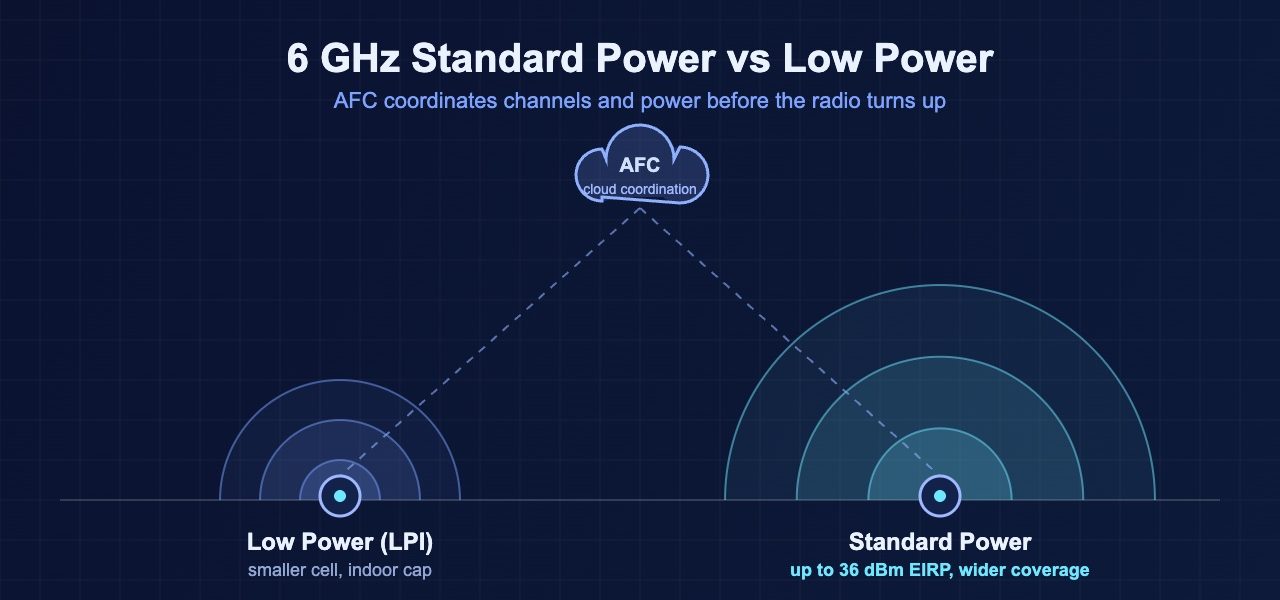
Enterprise vendors have promised for two years that 6 GHz would transform your wireless network. However, most of that promise sat behind a power limit. Indoor 6 GHz access points have run in low power mode, which caps their range and coverage. Now a higher power class called standard power is arriving. As a result, the coverage story finally starts to match the marketing slide. In this post I explain what 6 GHz standard power Wi-Fi actually delivers, and where the hype ends.
Standard power changes the coverage math
Standard power lets a 6 GHz access point transmit at up to 36 dBm EIRP. For comparison, low power indoor mode tops out far below that ceiling. Consequently, a single standard power radio covers more floor area with usable signal. In practice, this means fewer access points for the same coverage, or stronger 6 GHz where you already have dead spots. Furthermore, clients hold onto the wide 6 GHz channels at greater distance. That matters because 6 GHz is where the clean spectrum and the 320 MHz channels live. Nevertheless, the benefit only shows up if your client devices support 6 GHz in the first place.
How AFC decides what you can use
Standard power does not come for free. Specifically, it requires a cloud service called Automated Frequency Coordination, or AFC. The 6 GHz band is shared with licensed incumbents such as fixed microwave links. Therefore, an access point cannot simply run at full power wherever it sits. Instead, it reports its location to an AFC system. The system returns the exact channels and power levels that are safe at that spot. In other words, the network asks permission before it turns up the power. Importantly, this depends on an accurate location, so units near windows and exterior walls need reliable positioning.
Where Canada actually stands
Canadian rules follow their own track. ISED governs the 6 GHz band under RSS-248, which already covers low power, very low power, and standard power devices. Additionally, DBS-06 sets the technical rules for AFC system operators in Canada. For this reason, a US approval does not automatically apply north of the border. Meanwhile, ISED has not yet opened the very high power path that some other regions are exploring. In short, standard power with AFC is the ceiling for licence exempt 6 GHz here today. Ultimately, plan around what Canadian regulation actually permits, not a vendor slide built for the US market.
What this means for your next refresh
Standard power is real, but it is not a switch you simply flip on. Specifically, confirm that your access points and controller support standard power and AFC in Canada. Additionally, check whether your client fleet can even use 6 GHz, because many older laptops and phones cannot. Then validate coverage with a real site survey rather than a predictive model alone. In practice, the power increase shifts cell sizes enough to change your whole channel plan. Therefore, a design that assumed low power 6 GHz may over cover or under cover once standard power turns on. That said, when the devices and the survey line up, standard power is a genuine step forward for real world coverage.
At Baiden Group, we design and survey enterprise wireless networks across Canada, and 6 GHz planning is now part of every refresh conversation. Whether you need an RF site survey, a fresh Wi-Fi design, or troubleshooting on a network that underperforms, we validate the real environment before anyone turns up the power. Have questions about how these developments affect your network? Reach out to the Baiden Group team.