When users complain about weak Wi-Fi, the first instinct is to turn the access points up. It feels logical. More power should mean more coverage. However, on an enterprise network, that move usually makes things worse. In this post I explain how access point transmit power actually works, why cell size matters more than raw signal, and how to set power so devices behave.
Wi-Fi Is a Conversation, Not a Broadcast
Every Wi-Fi connection runs in two directions. The access point talks to the device, and the device talks back. Importantly, both sides must hear each other for the link to work.
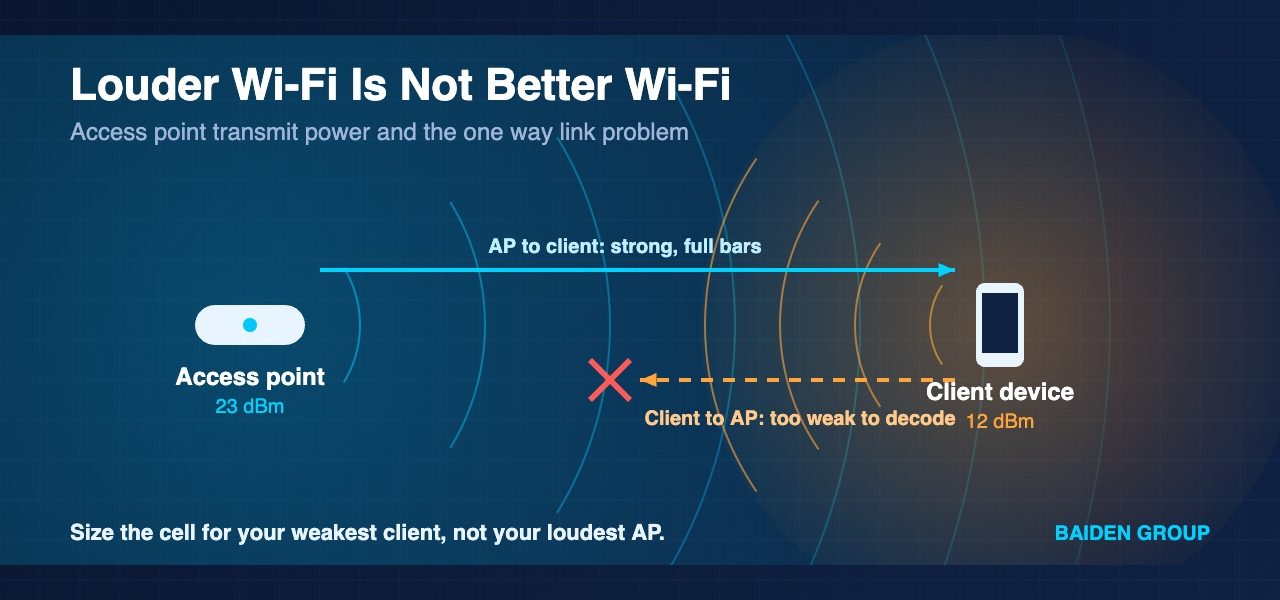
Most enterprise APs transmit at 20 to 23 dBm or more. In contrast, a typical smartphone transmits somewhere around 12 to 15 dBm. Handheld scanners, badges, and medical devices often sit in the same low range. Consequently, the device hears the AP far beyond the distance where the AP can hear the device.
That gap creates a power mismatch. The phone sees strong bars and assumes the link is good. Meanwhile, the AP struggles to decode the weak reply coming back. As a result, retries climb, data rates drop, and calls break up. In other words, the network looks full strength from the user’s seat and still performs badly.
Why Bigger Cells Hurt Performance
Each AP covers an area we call a cell. Turning up transmit power stretches that cell outward. Unfortunately, bigger cells create three problems at once.
First, devices hang on too long. The client decides when to roam, not the AP. Therefore a loud AP convinces the device to stay put long after a closer AP would serve it better. Second, bigger cells overlap more on the same channel. In practice, that means more co-channel contention and less airtime for everyone. Third, distant clients connect at low data rates. Slow clients take longer to send the same data, so they drag down every device sharing that cell.
In short, louder APs spread a fixed amount of airtime across a larger crowd. Smaller, well planned cells do the opposite. They keep clients close, keep data rates high, and give each device a fair share of airtime.
How to Set Transmit Power the Right Way
Start with your weakest client, not your best AP. Identify the device that matters most and transmits at the lowest power. For example, in a warehouse that might be a handheld scanner. Similarly, in a hospital it might be a wireless phone or an infusion pump. Then design cells so that device can reliably reach the AP.
Next, match AP power to that client within a reasonable margin. Generally, I keep 5 GHz radios well below maximum on most open office floors. Additionally, I set 2.4 GHz radios roughly 3 to 6 dB lower than 5 GHz. That offset keeps 2.4 GHz cells from outrunning the 5 GHz cells and pulling dual band clients onto the slower band.
Also, set sensible limits on automatic power control. Every major vendor offers radio resource management that adjusts power on its own. That said, left unbounded, it often pushes some radios to full power and drops others to the floor. Specifically, define a minimum and maximum power range for each band. Then let the automation work inside those guardrails.
Finally, validate on site. A predictive model tells you what should happen. Only a survey with real client devices tells you what actually happens. With that in mind, walk the floor with the devices your staff use, and measure both directions of the link.
What This Means for Canadian IT Teams
Many networks I walk into run every radio at full power. Usually, nobody chose that setting on purpose. Instead, it came from vendor defaults, a rushed install, or a well meaning fix for a single complaint. Over time, those quick fixes stack up into a network that looks strong on paper and fails under load.
Canadian buildings add their own challenges. Concrete cores, energy efficient glazing, and older mixed construction all change how far signal travels. Moreover, many organizations run a mix of old and new devices. Notably, older clients often transmit at even lower power. Consequently, power settings copied from another site rarely fit yours.
If your users see full bars and still complain, transmit power is one of the first settings I check. Ultimately, lower power, planned cell sizes, and a validated design almost always beat brute force.
At Baiden Group, we design Wi-Fi networks around the devices you actually use. Our RF site surveys measure real client behaviour, not just AP signal. Furthermore, our troubleshooting work regularly traces weak Wi-Fi complaints back to power and cell sizing. We also offer managed Wi-Fi, so your settings stay tuned as your building and devices change.
Have questions about how these developments affect your network? Reach out to the Baiden Group team.