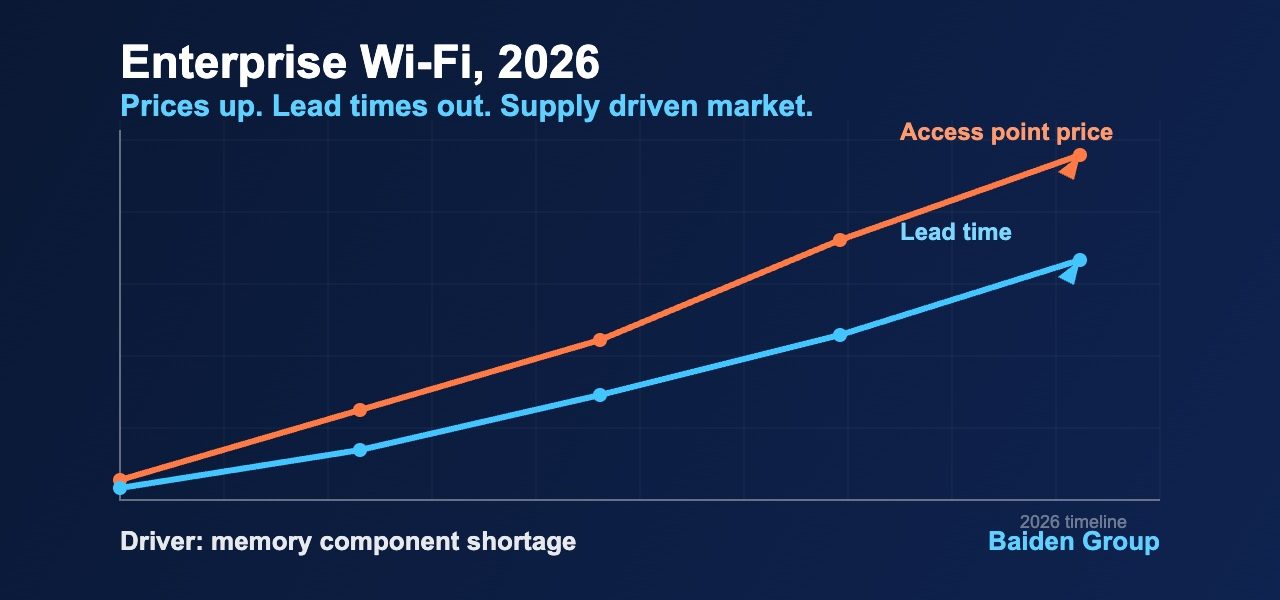
Enterprise Wi-Fi buyers are facing a market that has changed fast. New numbers from Dell’Oro Group show the wireless LAN market grew by double digits again in the second quarter of 2026. However, the more important story for Canadian IT teams is not the growth. It is the pressure now building on enterprise Wi-Fi hardware prices, and the lead times that come with it.
What the latest market data actually says
Wi-Fi 7 now makes up more than half of the enterprise WLAN market. Vendors also shipped a record number of access points in the quarter. Notably, they shipped the most access points ever with multi-gig and 10 Gbps uplinks. Growth was strong across every region, and Europe led the pack.
Meanwhile, average selling prices rose only moderately despite the surge in shipments. That detail matters. It suggests buyers pulled orders forward on purpose. In other words, many teams placed orders early to get ahead of price increases they already saw coming.
Why prices are climbing and lead times are slipping
The root cause sits below the access point itself. Memory components are still in short supply, and that shortage has not eased. Consequently, hardware prices are expected to keep rising through the rest of the year. At the same time, lead times have turned variable in what analysts now call a supply driven market.
For a Canadian IT team, this changes the math on timing. Additionally, currency swings and cross border shipping add cost that a US market report never shows. Therefore, the quote you received three months ago may not hold when you finally sign.
What this means for your next refresh
First, do not sit on a quote and assume it will wait. Prices and availability move week to week right now. For this reason, treat a vendor quote as a short window, not a standing offer.
Second, order early and order the right count. In practice, that means running your site survey before you buy, not after. A proper RF survey tells you exactly how many access points you need and where they go. As a result, you avoid both over ordering and the scramble of a second order at a higher price.
Third, do not wait for Wi-Fi 8. Some Wi-Fi 8 revenue may appear as early as next year. However, Wi-Fi 7 adoption will keep rising into 2028, and it is the mature, shipping choice today. For most Canadian enterprises, Wi-Fi 7 is the right buy for this cycle.
Finally, line up your budget approval with reality. Many organizations still run on a quarterly or annual purchase cycle. Meanwhile, prices and stock move on a weekly one. As a result, an approval that takes six weeks can cost you the price you were promised. For this reason, get the survey and the design done first, so the numbers are ready the moment funding clears. In short, the paperwork should never be the thing that holds up a good quote.
Do not forget the wiring behind the radio
Record shipments of multi-gig and 10 Gbps access points point to a second cost. Specifically, those radios need switching and cabling that can actually feed them. Many older buildings run cabling that cannot support multi-gig uplinks. Consequently, a Wi-Fi refresh often turns into a switch and cabling project too. Plan for that now, because cabling lead time can outlast the access point lead time.
The takeaway is simple. Buy on a plan, not on a deadline. At Baiden Group, we design wireless networks, run RF site surveys, troubleshoot problem sites, and manage Wi-Fi for teams across Canada. Ultimately, a good survey and a clear design protect you from paying more for the wrong gear at the wrong time.
Have questions about how these developments affect your network? Reach out to the Baiden Group team.