The last two weeks brought a cluster of enterprise Wi-Fi news worth a closer look. None of it calls for a panic purchase. However, each story changes a question your team should ask before the next refresh. Here is what happened and what it means for IT teams in Canada.
Cisco Announces a Quantum Resilient Wi-Fi 7 Access Point
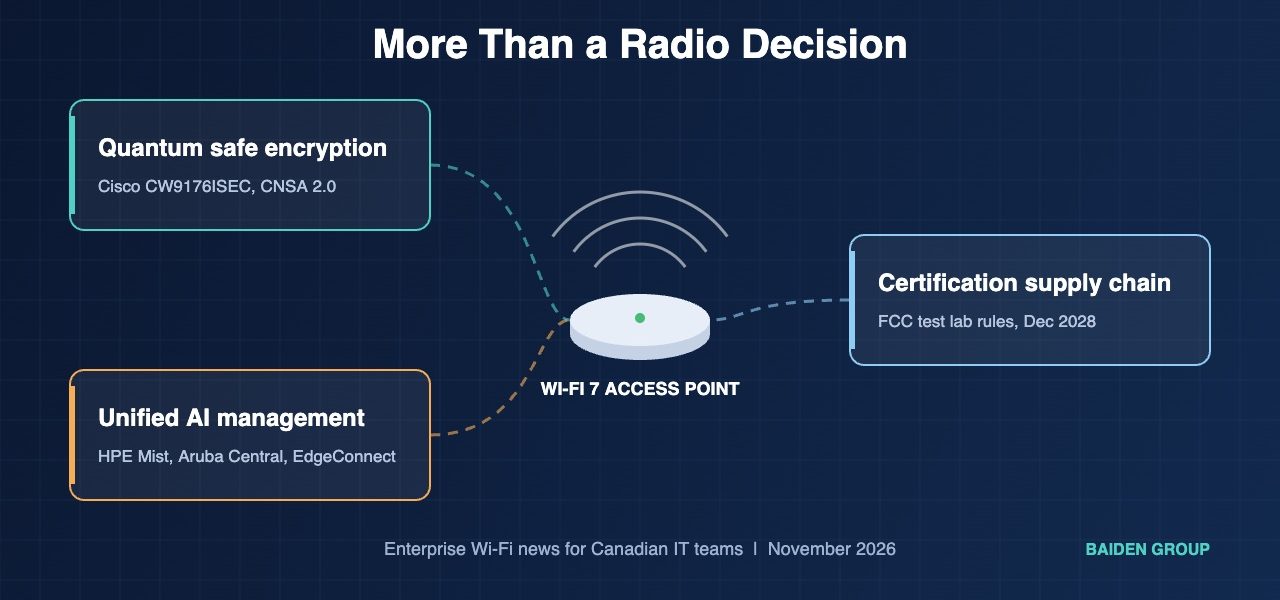
On October 26, Cisco announced the CW9176ISEC. It is a Wi-Fi 7 access point positioned as quantum safe and aligned with the NSA’s CNSA 2.0 guidance. Cisco says it is working with Qualcomm, Intel and Microsoft on post quantum cryptography across the wireless link. Availability is planned for January 2027.
Specifically, the concern is a pattern called “harvest now, decrypt later.” An attacker records encrypted traffic today and waits for a quantum computer to break it. For most offices, that threat is distant. For example, federal departments, defence suppliers, banks and hospitals hold data that must stay private for decades. Those organizations should pay attention now.
Importantly, an access point is only one end of the conversation. The client chipset, the operating system and the authentication server all need matching support. Therefore, one quantum safe AP model does not make a network quantum safe. In practice, the useful step today is an inventory. Know which systems carry sensitive data with a long shelf life. Also, know which clients would need upgrades to support stronger cryptography.
HPE Pulls Mist, Aruba Central and EdgeConnect Together
On October 27, HPE announced that Mist, Aruba Central and EdgeConnect will share a common agentic AI framework. Marvis will act as the AI engine across all three. Meanwhile, EdgeConnect integration with Mist is planned for this year. Aruba Central integration is expected in the first half of 2027.
Notably, many Canadian organizations run Aruba today and have watched the Juniper merger with some uncertainty. This announcement suggests HPE plans to converge management rather than retire a platform outright. That said, roadmaps shift. Furthermore, “agentic AI” is a marketing phrase until you see what it changes on your network.
For this reason, ask your vendor for specifics. Which actions can the AI take without approval? How are those actions logged? Can you roll them back? Similarly, ask how licensing will work once the platforms converge. In short, those answers matter more than the demo.
The FCC Tightens Rules on Wireless Test Labs
The FCC has adopted rules that limit equipment testing and certification to US labs and labs in countries with reciprocal recognition. The restrictions take effect on December 1, 2028. According to Wi-Fi NOW, the rule effectively excludes labs based in China from certifying access points, routers and phones for the US market. The FCC reportedly said about 82% of electronic devices were previously tested in China.
Canada runs its own certification process through ISED. Nevertheless, most enterprise gear sold here is designed for the US market first. As a result, a shift in US lab capacity could affect launch timing and pricing on both sides of the border. Two years is a long runway. Still, it is worth building some slack into refresh plans that span several years.
What Ties These Stories Together
Meanwhile, the market keeps moving fast. IDC reported that enterprise WLAN revenue reached US$3.2 billion in the second quarter of 2026, up 23.2% year over year. Wi-Fi 7 made up about 53% of dependent access point revenue. In other words, Wi-Fi 7 is now the default purchase rather than the early adopter choice.
Ultimately, the access point is becoming a smaller part of the decision. Security posture, management platform and supply chain now carry as much weight as radio specifications. A good design still starts with RF. However, the procurement conversation has grown much wider.
At Baiden Group, we help Canadian organizations separate vendor claims from field reality. Our team provides Wi-Fi design, RF site surveys, troubleshooting and managed Wi-Fi. In addition, we can help you build requirements that hold up beyond the next product cycle.
Have questions about how these developments affect your network? Reach out to the Baiden Group team.