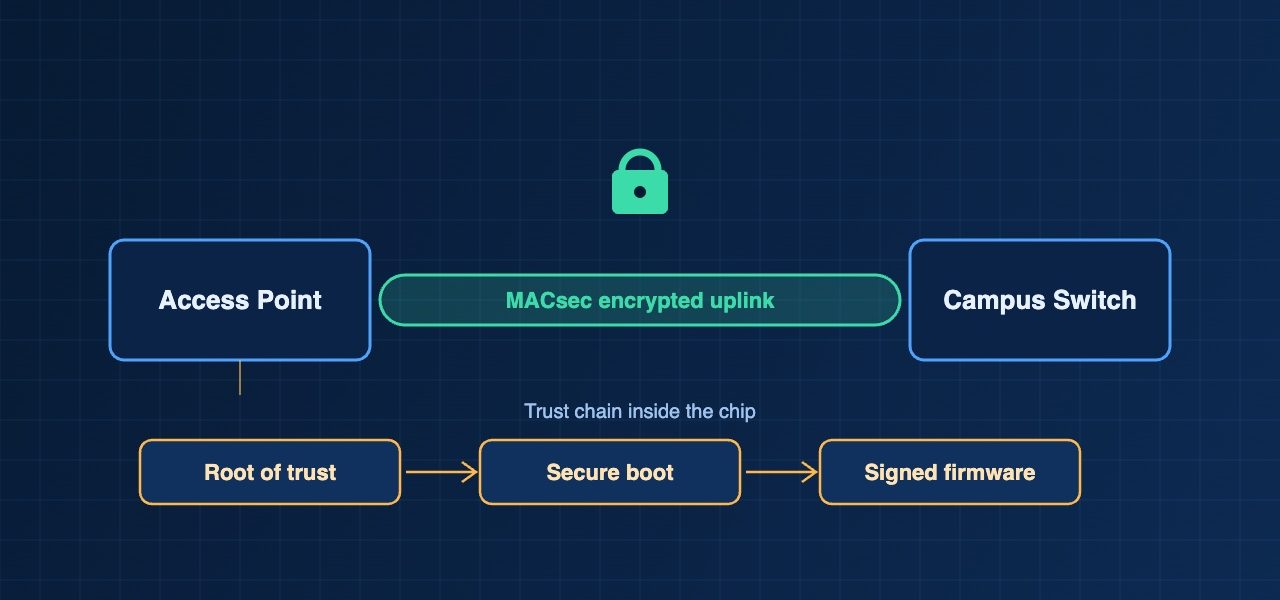
Security used to be something we configured on a controller. Now it is moving into the silicon. Earlier this year, Broadcom announced enterprise Wi-Fi 8 chips for access points and campus switches. The announcement also listed hardware security features. For example, it cited MACsec, secure boot, a hardware root of trust, and support for post quantum cryptography.
However, Broadcom is only sampling these parts to early customers. Therefore, no shipping access point has them yet. Even so, the direction matters for anyone planning a refresh this year or next. Buyers who ask the right questions now will avoid costly surprises later. Enterprise Wi-Fi security is becoming a hardware question, not only a software setting.
What Broadcom Actually Announced
Broadcom described one processor and three radio chips for enterprise access points. It also described a campus switch chip with up to 48 multigigabit ports. In addition, the company pointed to wireless time sensitive networking based on IEEE 1588 Precision Time Protocol. That feature aims to reduce latency variation.
Importantly, Broadcom gave no speed figures. Qualcomm has said Wi-Fi 8 targets stability, latency, and device density rather than peak speed. Overall, this is a reliability and security story. It is not a speed story. Vendors will still market it with big numbers, so read the fine print.
Furthermore, a unified design lets the chips collect data across wired and wireless segments in real time. In theory, that gives IT teams one view of a fault instead of two. Of course, that depends on how each vendor builds its tools on top of the silicon.
Why Hardware Security Matters
MACsec encrypts traffic between the access point and the switch. In practice, that closes a gap many networks leave open. Today, a person with physical access to a ceiling cable run can often tap traffic on the uplink. Similarly, secure boot checks that the access point runs trusted firmware at startup.
A hardware root of trust anchors that check inside the chip itself. As a result, a tampered unit is much harder to pass off as legitimate. For hospitals, airports, and government sites, these controls answer real audit questions. Moreover, post quantum support addresses a longer term concern about recorded traffic being decrypted years from now.
What Canadian IT Teams Should Do Now
First, do not delay a needed Wi-Fi 7 project for chips that are still in sampling. Reports suggest Wi-Fi 8 launches around 2028. Meanwhile, your current network still has to pass audits today.
Second, put direct questions into your next RFP. Does the access point support MACsec on the uplink? Is secure boot enforced, and can you verify it? How is firmware signed? Which post quantum algorithms are on the roadmap, and will they arrive by software update or only on new hardware?
Additionally, check the switch side. Switch ports often outlast access points by many years. For that reason, a multigigabit switch purchase deserves the same scrutiny. Ask whether the ports you buy now will support MACsec later.
Likewise, plan for cost. New security features rarely arrive free. For instance, vendors may tie some functions to licences or subscriptions. Consequently, ask for a full price list that separates hardware from recurring fees before you compare bids.
Where Design and Surveys Still Come First
Security hardware does not fix poor coverage. A well secured access point in the wrong spot still drops calls. Therefore, design and RF site surveys remain the foundation of any good network.
At Baiden Group, we handle Wi-Fi design, RF site surveys, troubleshooting, and managed Wi-Fi. Specifically, we help teams write vendor questions into the RFP. We then verify the answers during acceptance testing. In short, ask for proof before you pay for a feature.
Have questions about how these developments affect your network? Reach out to the Baiden Group team.