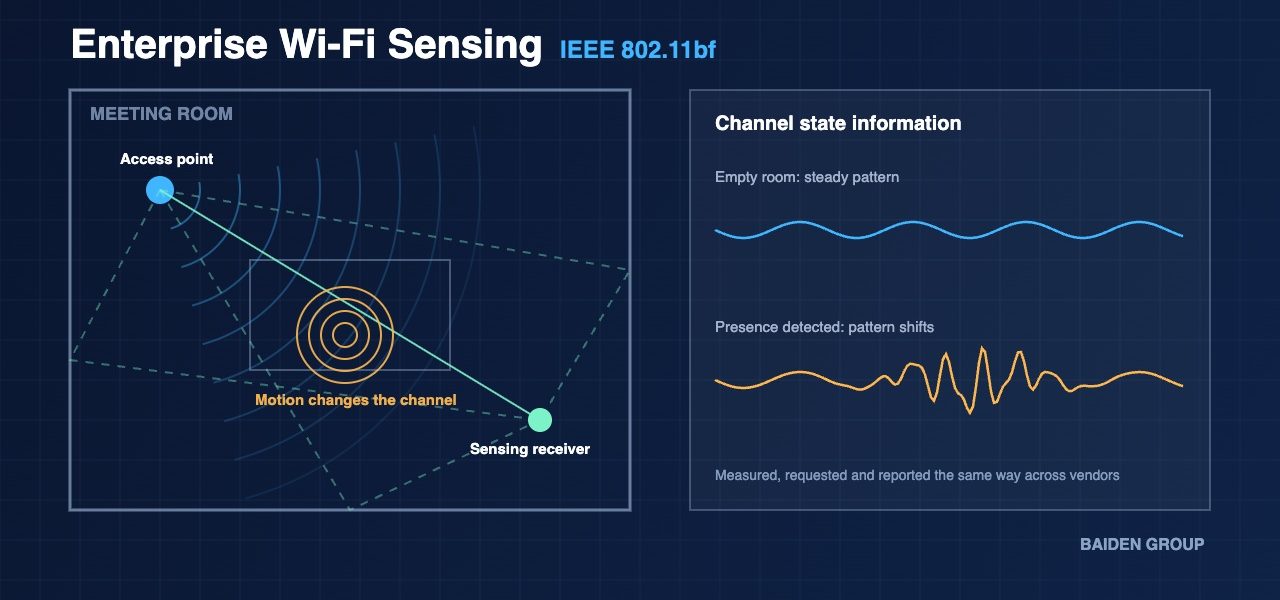
Your access points can now do more than carry traffic. Wi-Fi sensing uses the radio signals already in the air to detect motion and presence. In September 2025, the IEEE published 802.11bf, the first amendment written specifically for this job. Vendors are now folding it into their roadmaps and occupancy dashboards. However, the marketing is running well ahead of what most networks can deliver today. Here is what enterprise Wi-Fi sensing actually does, and what Canadian IT teams should ask before buying into it.
How Wi-Fi Sensing Works
Every Wi-Fi frame travels through the room before it reaches a receiver. Walls, furniture and people all change that signal along the way. A radio can measure those changes through channel state information, often called CSI. When a person walks through a space, the pattern shifts in a way software can detect. In short, the network becomes a motion sensor without adding a camera.
Before 802.11bf, every vendor did this in its own way. Some read CSI through proprietary chipset hooks. Others inferred presence from client device counts. As a result, sensing products rarely worked across mixed hardware. The new amendment defines a common procedure for requesting, collecting and sharing sensing measurements. Specifically, it covers the bands below 7 GHz and the 60 GHz band.
What 802.11bf Delivers
The standard gives devices a shared language for sensing. One device can ask another to transmit sounding frames on a schedule. The receiver then reports measurements back in a defined format. Consequently, a sensing application no longer depends on one chipset vendor’s private interface.
In practice, the near term use cases are modest and useful. Occupancy detection is the clearest one. A facilities team can see whether a meeting room is empty without installing a sensor in every ceiling. Similarly, motion detection after hours can feed a building automation system. Some vendors also pitch fall detection in care settings.
Notably, the 60 GHz portion offers finer resolution than the lower bands. That said, 60 GHz radios are rare in enterprise access points. Most deployments will rely on the 2.4, 5 and 6 GHz radios already installed.
What Vendors Overstate
A published standard does not mean your network supports it. Sensing needs support in the chipset, the firmware and the management platform. Moreover, both ends of the measurement usually need to cooperate. In fact, an older access point will not gain 802.11bf support through a software update unless the silicon allows it.
Accuracy is another gap. Sensing results depend heavily on the room, the furniture and where the radios sit. For example, a model trained in an open office may misread a lab full of metal shelving. Therefore, treat vendor accuracy figures as lab numbers until you see results in your own building.
Airtime matters too. Sounding frames take time on the channel. On a busy network, aggressive sensing schedules can compete with client traffic. In contrast, a light schedule may miss short events. Someone has to tune that balance, and it rarely appears in the sales demo.
Privacy Questions Canadian Teams Should Ask
Sensing does not capture faces. Nevertheless, it can still reveal when people arrive, leave and gather. In a workplace, that data can become personal information quickly. Canadian organizations operate under federal and provincial privacy laws, and Quebec’s Law 25 sets particularly strict expectations. For this reason, bring your privacy officer in before any pilot starts.
Ask the vendor where it processes and stores sensing data. Also ask whether results are grouped by room or tied to individual devices. Finally, confirm how long the data stays on file and who can access it. Clear answers here will save a difficult conversation later.
How to Approach a Pilot
Start with one well defined problem, such as meeting room occupancy on a single floor. Then confirm that your access point models and controller software support the feature. Additionally, run the pilot alongside a known reference, such as door counts or booking data. That comparison tells you whether the results are good enough to act on. Ultimately, sensing should earn its place with measured results, not a feature checklist.
Wi-Fi sensing is a real capability with a real standard behind it. However, it works best on a network that is already well designed and well understood. Baiden Group helps Canadian organizations with Wi-Fi design, RF site surveys, troubleshooting and managed Wi-Fi. We can assess whether your current hardware supports sensing and whether a pilot makes sense for your building.
Have questions about how these developments affect your network? Reach out to the Baiden Group team.