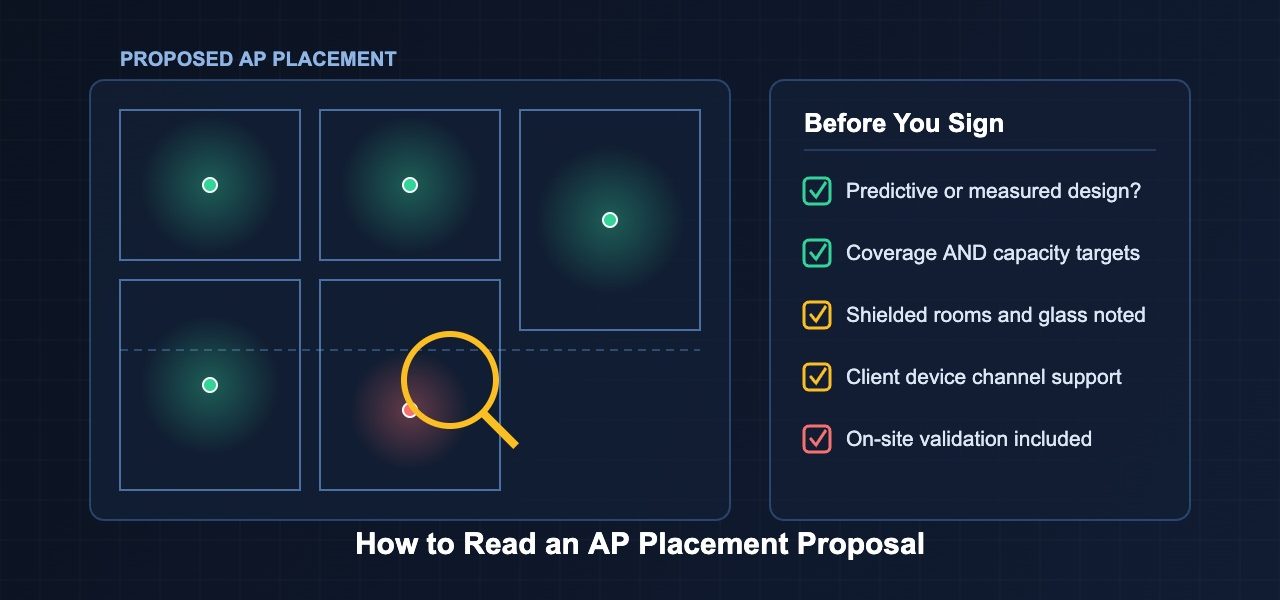
Most enterprise IT teams receive an AP placement proposal and skim straight to the price. However, the map of dots on your floor plan decides whether your wireless works for the next five years. Therefore, learning to read that proposal matters more than the quote at the bottom. In practice, a weak design costs far more than a good one. This guide shows you what to check before you sign.
Ask What the Design Is Actually Based On
First, find out how the vendor produced the placement. Generally, a proposal comes from one of two methods. A predictive design uses software and a floor plan. A measured design uses a real survey on site with calibrated tools. However, a predictive design is only as good as the data fed into it. For example, wall materials, ceiling height, and glass type all change how signal travels. In fact, many predictive designs assume ordinary drywall everywhere. Consequently, the model promises coverage that the building will never deliver. Ask which method was used. If it was predictive only, ask whether anyone walked the site.
Check the Coverage and Capacity Targets
Next, look for the numbers the design commits to. Specifically, a real proposal states a target signal strength and a signal to noise ratio. It also states how many devices each area must support. Notably, coverage and capacity are not the same thing. A room can show full signal and still collapse under a crowd. For instance, a convention hall with strong bars still fails when hundreds of heavy users arrive at once. Therefore, the proposal should match AP count to device density, not just floor area. If it only mentions coverage, treat that as a warning sign.
Find What the Design Leaves Out
Then, hunt for the gaps. In practice, the most expensive mistakes hide in what a proposal never mentions. For example, shielded rooms block signal completely. Lead lined dental operatories and imaging suites need an AP inside the room, not nearby. Similarly, Low-E glass reflects RF and kills outdoor coverage fed from indoor APs. Additionally, older client devices cannot see 6 GHz or some DFS channels. Consequently, a channel plan built around the newest AP spec sheet may strand half your fleet. A good proposal names these obstacles. A weak one pretends they do not exist.
Demand On-Site Validation
Finally, insist on validation. However good the design looks on paper, RF behaves differently inside a real building. Therefore, the proposal should include a post-installation survey. During that survey, a specialist walks the floor and measures actual signal, noise, and roaming. As a result, you learn whether the install meets the targets you were promised. Without validation, you are trusting a model instead of measurements. In short, a design with no validation step is only half a job.
The Bottom Line
Overall, an AP placement proposal is a plan you will live with for years. Read it like one. At Baiden Group, we design wireless networks, run RF site surveys, troubleshoot broken deployments, and manage Wi-Fi for clients across Canada. Above all, we validate every design on site before we call it finished.
Have questions about how these developments affect your network? Reach out to the Baiden Group team.