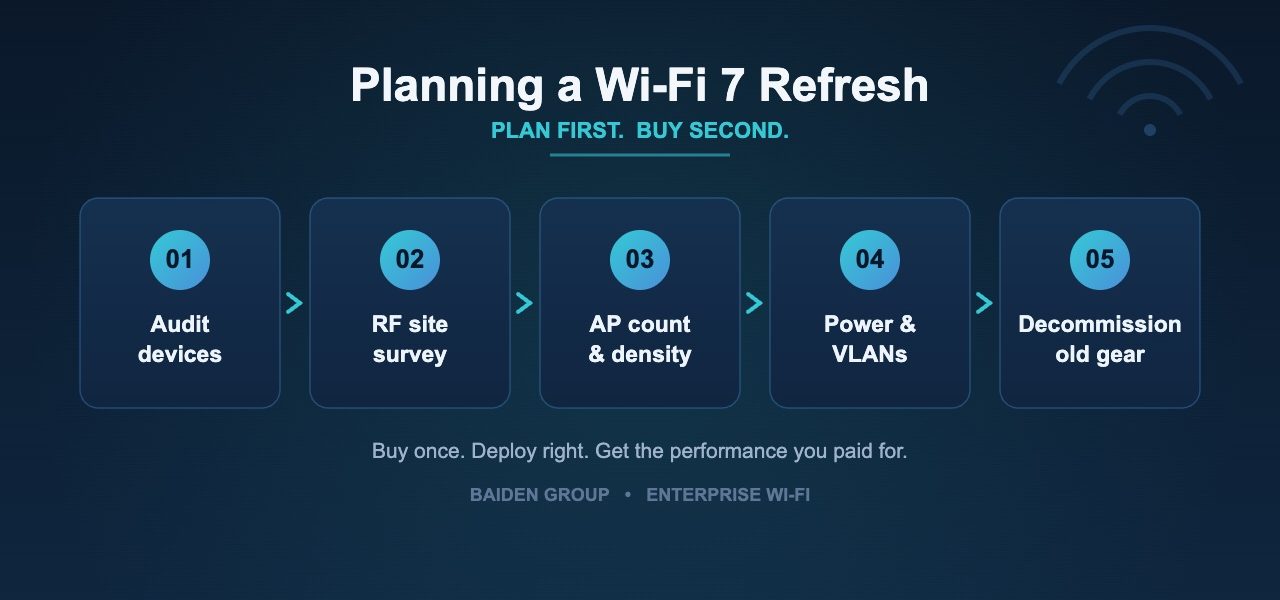
Wi-Fi 7 is on every vendor’s roadmap, and the sales pitch is loud. However, a new access point does not fix a network on its own. In practice, most Wi-Fi 7 refreshes waste money because the planning happens after the purchase order, not before it. Here is how I plan a Wi-Fi 7 refresh from the field, so you buy the right gear and get the performance you paid for.
Audit your client devices first
Before you price a single access point, look at what connects to your network. The access point is only half of the link. Your laptops, scanners, phones, and sensors are the other half. Wi-Fi 7 delivers its gains on 6 GHz and on the wider channels. However, a device that cannot see those channels will never use them. For example, a five year old barcode scanner will not roam onto 6 GHz. Therefore it sits on the old bands while your new radios idle. Anything older than roughly ten years deserves a hard look. In fact, many older clients cannot even see DFS channels in 5 GHz, let alone 6 GHz. Build the plan around what your fleet can actually reach, not the spec sheet on the box.
Survey before you buy, not after
Vendors love a predictive design because it is fast and free. However, a predictive model is only as good as the inputs someone feeds it. Generally, those inputs are wrong. The design team guesses at wall materials. Nobody asks about the glass type. Ceiling heights turn into rough estimates. As a result, the model predicts coverage that the building will never deliver. A real RF site survey walks the floor with a spectrum analyzer and measures what is actually there. For instance, I have found walls lined with lead, metallic window coatings, and interference sources that no floor plan would ever show. Spend the survey money up front. It costs far less than moving access points you mounted in the wrong place.
Get the access point count right
More access points is not more coverage. Often it is more interference. When radios sit too close on the same channels, they talk over each other and airtime collapses. For example, I have walked into a building and counted the access points from the front door. Subsequently, I spotted too many radios before anyone even spoke. Density has to match the real demand in each space. Notably, a quiet office and a packed convention hall need very different designs. Therefore, map your high density zones, your roaming paths, and your dead corners separately. Then place radios to serve each space, rather than blanketing the floor with one layout.
Plan the wired side and the power budget
A Wi-Fi 7 access point is hungry. Specifically, many models want more than a standard PoE switch port can deliver. Consequently, teams cut over the wireless and then find their switches cannot power the new radios at full capability. Check the PoE budget on every switch before you order. Confirm your cabling can carry the throughput too, because a fast radio behind a slow uplink is just an expensive bottleneck. In addition, plan the VLANs and the SSID to VLAN mapping before the cutover, not during it. A missed mapping strands clients on a dead network.
Decommission the old gear cleanly
Decommissioning is not a “pull it later” task. A refresh ends only when every old radio goes dark. I once chased dropped sessions back to a single forgotten access point that someone left powered after a refresh. That radio still had power, still broadcast the old SSID, and still handed devices a dead end. Meanwhile, the staff on the floor lost work and blamed the new network. For this reason, confirm every legacy radio is off, every switch port is documented, and every SSID maps to the right network before you call the project complete.
In short, a Wi-Fi 7 refresh pays off when the plan comes first and the purchase order comes second. At Baiden Group, we run the RF site surveys, design the network around your real devices, and troubleshoot the problems a spec sheet never predicts. Ultimately, the goal is simple. Buy once, deploy right, and get the performance you paid for. Have questions about how these developments affect your network? Reach out to the Baiden Group team.