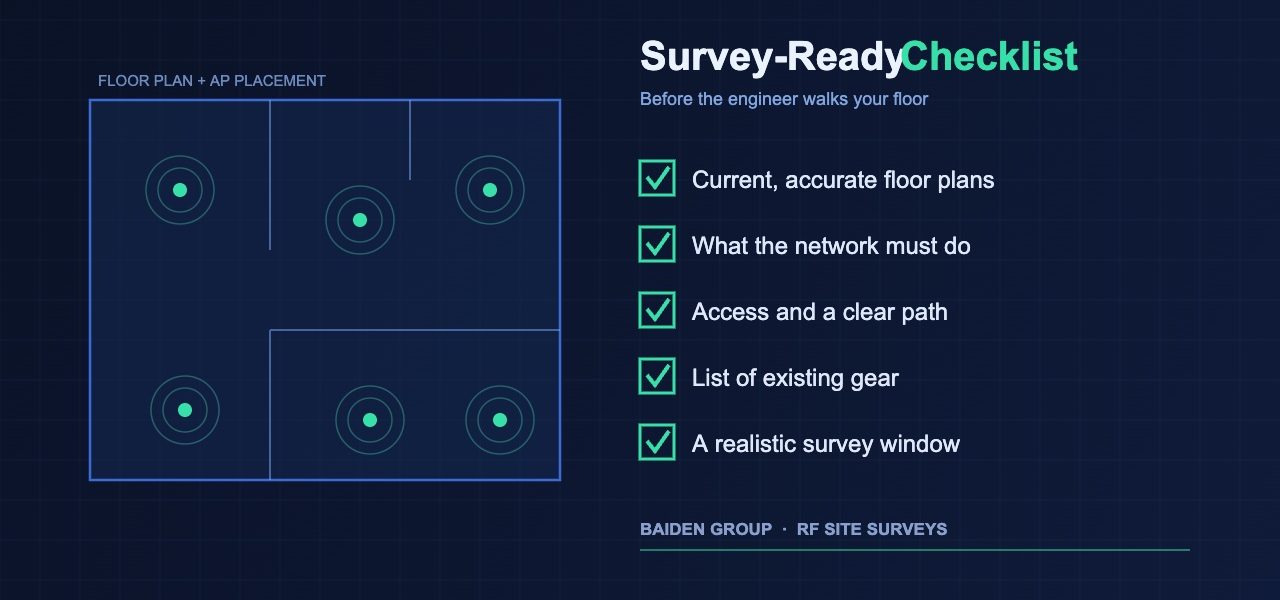
A good RF site survey depends on more than the specialist who shows up with an Ekahau kit. Preparation on your end shapes the quality of the results. In fact, the cleanest surveys I run happen at sites that did their homework first. Below is what I ask every client to have ready before I walk the floor.
Share your real floor plans
Give the survey team accurate, current floor plans before the visit. Notably, outdated drawings waste hours and produce coverage maps that lie. For example, a wall added last year changes how signal travels through a space. Additionally, mark ceiling heights, construction materials, and any dead zones you already know about. As a result, the specialist models propagation against reality instead of a guess.
Define what the network must do
Coverage alone means nothing without context. Specifically, tell the survey team what the space is actually for. A warehouse running handheld scanners needs a different design than an office running video calls. Similarly, high-density spots like cafeterias and lecture halls demand tighter capacity planning. Consequently, the survey targets your real use, not a generic signal benchmark. In practice, this single step separates a useful report from a pretty one.
Clear the access and clear the path
Physical access decides whether a survey finishes on schedule. Meanwhile, locked rooms, secured floors, and escort rules quietly stall the work. For this reason, confirm badge access and a point of contact ahead of time. In addition, clear tall racks or covered ceilings where a specialist needs a clean line of sight. Otherwise, half a day of survey time disappears into logistics.
Document the gear you already own
Hand over a current list of access points, models, and firmware versions. Moreover, share read access to your controller or cloud dashboard if you have it. In practice, this shows what you already own before anyone recommends new hardware. That said, do not assume the survey exists to validate your current design. Instead, treat it as an honest second opinion on what is really happening in the air.
Set a realistic survey window
Survey timing matters more than most teams expect. Generally, a live survey during business hours captures real interference and real client load. However, some sites need an after-hours pass to reach secured or noisy areas. Therefore, decide early whether you want a passive walk, an active survey, or both. Ultimately, matching the method to your goals saves a costly return visit.
Why this preparation pays off
Good prep is not busywork. Rather, it turns a one-day site visit into data you can actually build a network on. At Baiden Group, we run RF site surveys, Wi-Fi design, troubleshooting, and managed Wi-Fi across hospitals, warehouses, schools, and government sites. Notably, the clients who prepare well get sharper findings and fewer surprises at install. In short, the survey is only as good as the ground truth you give it.
Have questions about how these developments affect your network? Reach out to the Baiden Group team.