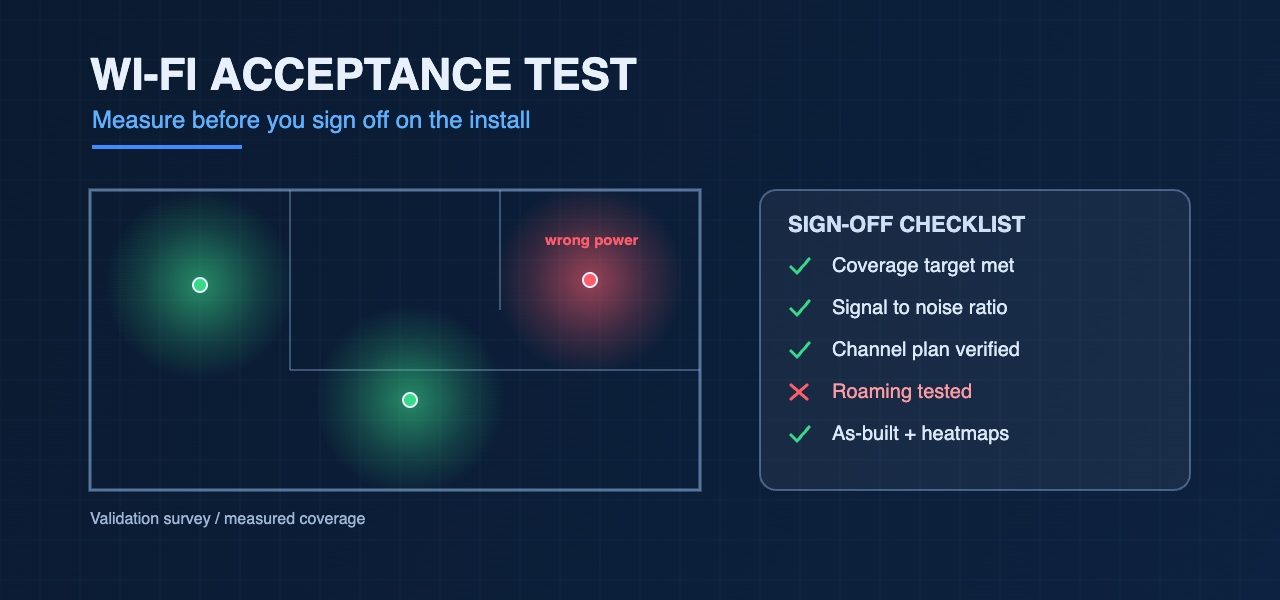
A wireless installation is not done when the last access point reaches the ceiling. It is done when someone proves it works. However, many enterprise IT teams sign the completion form because a vendor says the job is finished. Then the trouble tickets start arriving. For this reason, a proper Wi-Fi acceptance test protects you before you release final payment.
Why a Wi-Fi acceptance test matters
An installer can mount every access point exactly where the design shows. That alone does not guarantee coverage. Cables get mislabeled. Access points get left on the wrong power. Channels overlap whenever someone skips the tuning step. Therefore the only way to know the network performs is to measure it after the work is complete. In practice, a design promises coverage and an acceptance test confirms it. Additionally, a signed test gives you leverage if problems surface months later.
What to measure on site
Start with a validation survey using the same tools a good designer would use. Specifically, walk the floor with a survey kit and record signal strength, signal to noise ratio, and data rates in every area that matters. Coverage should meet the target the design promised, usually around minus 65 dBm for most enterprise spaces and stronger where voice or handheld scanners run. Additionally, confirm that each access point sits on the correct channel and the correct power. Co-channel interference hides easily, so verify the channel plan rather than trusting it. For roaming, test a device while you walk between access points and confirm it moves cleanly without dropping. In fact, roaming is where most installs quietly fail, because coverage can look fine while the handoff does not.
Documents to demand before sign-off
A verbal all clear is not a deliverable. Instead, ask for a post-installation validation report with heatmaps built from an on-site survey, not a predictive model. Moreover, the report should show measured coverage, SNR, channel assignments, and access point locations as built. Request an as-built diagram and a list of every access point with its name, MAC address, channel, and power. For managed environments, confirm that monitoring and alerting are live before the crew leaves the building. Overall, if a vendor cannot hand you measured proof, the job is not finished.
Common failures an acceptance test catches
I have walked into plenty of sites where the install looked perfect and the network still failed. For example, one access point left on factory default power flooded an entire floor and broke roaming. Elsewhere, a mislabeled cable put an access point on the wrong VLAN, so clients associated and then went nowhere. Similarly, skipped channel tuning created co-channel interference that nobody caught until users complained. Notably, none of these problems show up in a photo of a ceiling. They only show up when you measure. That is the entire point of a Wi-Fi acceptance test.
When to run the test and who should run it
Timing matters as much as method. Ideally, schedule the acceptance test after the install crew finishes but before they demobilize, so any fixes happen while ladders and gear are still on site. Additionally, run the test under realistic conditions rather than an empty building at midnight. A warehouse fills with racks and metal, and a hospital fills with people and equipment, so measure the space the way it actually gets used. For independence, use someone other than the installer to validate the work. Consequently, the party that gets paid is not the same party that grades the job. That separation is not an insult to the installer. Instead, it is basic quality control, and good installers welcome it because clean results protect them too.
An acceptance test is cheap compared to a failed rollout. At Baiden Group, we run independent post-installation validation surveys, design wireless networks, troubleshoot the ones that misbehave, and manage Wi-Fi for teams that would rather not. In short, we measure what others assume. If you are about to sign off on an install, get it validated first. Have questions about how these developments affect your network? Reach out to the Baiden Group team.