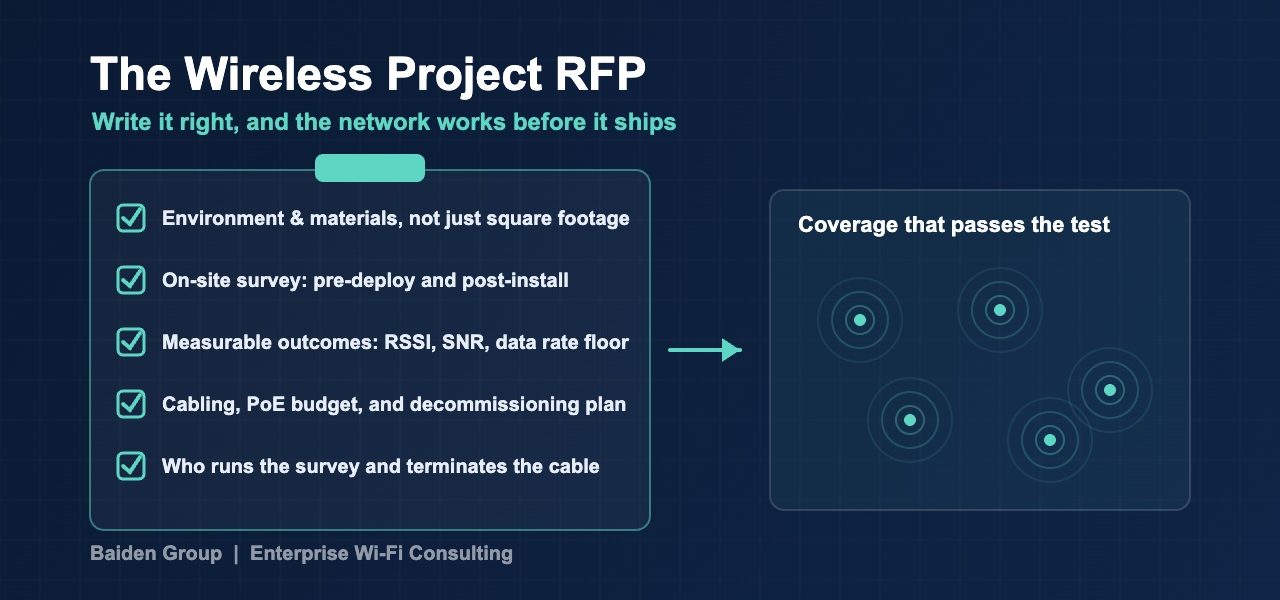
Most enterprise Wi-Fi projects go wrong before a single access point ships. The request for proposal sets the terms, and a weak one invites weak bids. In my experience, a vague document gets you vague results. Therefore, the RFP you write is the first real design decision you make.
Below is how I would build a wireless project RFP that protects your budget and gets you a network that works.
Describe the environment, not just the square footage
Vendors price what they can see. Consequently, a floor plan alone tells them almost nothing. Instead, describe the building materials, the ceiling heights, and any shielded or unusual rooms. For example, lead-lined operatories, Low-E glass, cold storage, and concrete tilt walls all change the access point count. Additionally, list the client devices that will connect. Handheld scanners, medical carts, and older laptops behave very differently from new phones. In short, the more physical detail you provide, the more accurate the bids become.
Demand a real site survey, not a predictive guess
A predictive design is only as good as its inputs. However, most predictive models assume ordinary walls and ordinary glass. As a result, they promise coverage that the building will never physically allow. For this reason, I always put an on-site validation survey in the scope. Specifically, require a pre-deployment survey to confirm the design and a post-installation survey to prove it. Furthermore, name the tool. Ekahau with a Sidekick is the standard I trust, and the deliverable should include heatmaps, not just an invoice.
Spell out the outcomes you will measure
Never accept “good coverage” as an acceptance criterion. Instead, write the numbers down. For instance, set a minimum signal level, a minimum signal to noise ratio, and a data rate floor in the areas that matter. Moreover, define coverage per area rather than one blanket figure. A warehouse aisle and a boardroom have different needs. Notably, tie payment to these numbers. When the acceptance test lives in the contract, the installer designs to pass it. Otherwise, you inherit the gap after everyone has gone home.
Cover the boring parts that cause the real failures
Cabling, power, and decommissioning cause more outages than radios do. Therefore, put them in the RFP explicitly. For example, require Cat 6a to every access point, confirm the PoE budget on the switches, and specify outdoor-rated cable for any exterior coverage. In addition, demand a decommissioning plan for the old gear. I have walked into sites where a forgotten access point still broadcast the production SSID and quietly dropped devices. Consequently, “pull it later” is not a plan. Every old radio must go dark, and every SSID must map to the correct VLAN before anyone calls the job done.
Ask who actually does the work
Finally, separate the sales team from the field team. Many firms bid a project and then send whoever is free that week. In contrast, you want to know who runs the survey and who terminates the cable. Additionally, ask for references in your own vertical. A company that has never worked a hospital or a dental office will miss things a veteran spots on sight. Similarly, ask how they handle problems found after the install, because the honest answer tells you how they will treat you once the invoice is paid.
Overall, a strong RFP does the same job as a good survey. It removes guesswork before money changes hands. At Baiden Group, we help Canadian IT teams scope wireless projects, run RF site surveys, troubleshoot networks that already went sideways, and manage Wi-Fi once it is live. Have questions about how these developments affect your network? Reach out to the Baiden Group team.