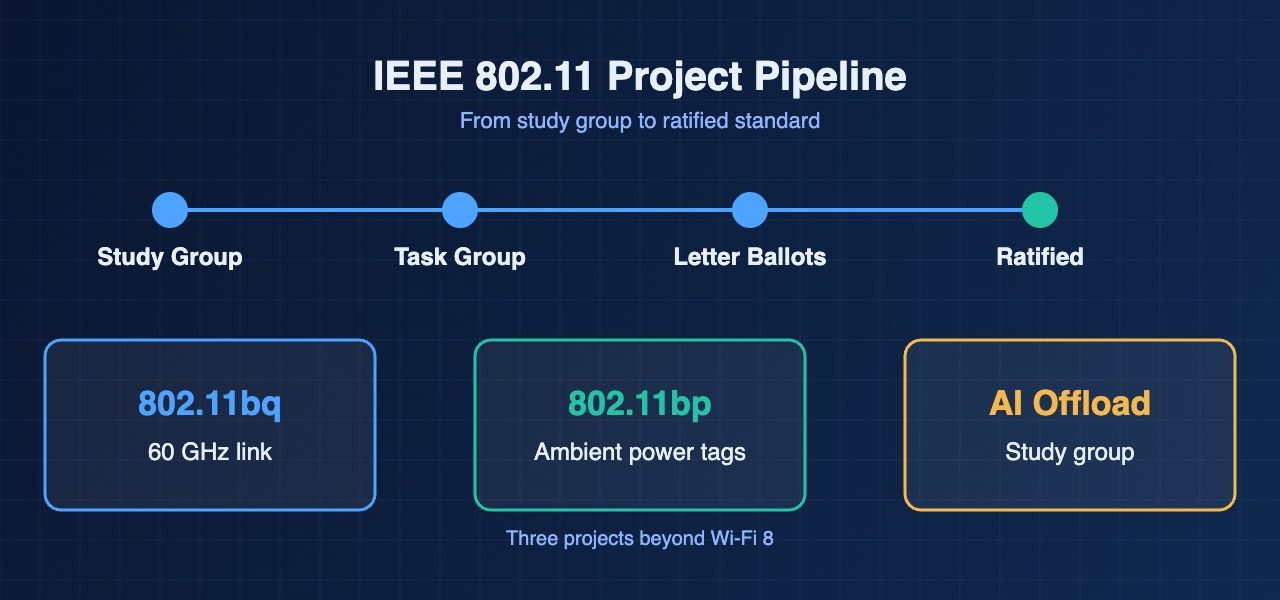
Most coverage of the IEEE 802.11 standards roadmap stops at Wi-Fi 8. However, the working group is also running smaller projects that could shape your next two refresh cycles. In this post, I look at three of them and explain what they mean for Canadian IT teams.
Specifically, these are 802.11bq, 802.11bp, and a new study group on AI offload. None of them will change your purchasing decisions this quarter. Still, each one points to where enterprise wireless is heading.
How the IEEE Process Sets Expectations
First, a quick note on how the work gets done. A study group defines the need. A task group then writes drafts, and members vote on them in letter ballots. Each ballot produces comments, and the group must resolve them before the next draft appears.
For example, the 802.11bn task group resolved about 1,850 comments in September 2026 while preparing its next draft. Moreover, its published schedule points to final approval in 2028. Earlier milestones have already slipped by roughly two months. As a result, treat every date in a standards schedule as a target, not a promise.
This matters for procurement. A draft number shows how far a project has travelled. Early drafts can change in major ways, while later drafts usually change only in detail. Therefore, a feature in an early draft should not drive a purchase order.
802.11bq: 60 GHz as Another Link
The 802.11bq project adds millimetre wave operation at 60 GHz. It could appear as one more link inside Multi Link Operation. That would give a device a short range, high capacity path alongside its 5 GHz and 6 GHz links.
However, 60 GHz does not pass through walls. Therefore, it suits rooms with clear line of sight, such as training labs and meeting spaces. It will not replace your general coverage design. Also, the amendment is still in progress, so details may change.
In practice, I picture it as a bonus link for a few special rooms. Specifically, a boardroom with heavy video traffic could benefit. Open offices and corridors would not.
802.11bp: Devices Powered by Radio Signals
The 802.11bp project covers ambient power devices. These are tags that harvest energy from radio signals and need no battery. A recent demonstration showed a tag communicating with a Wi-Fi device while powered only by that device’s emissions. The group targeted a first draft for September 2026.
For facilities teams, the appeal is clear. Battery free tags could track assets in warehouses and hospitals without battery swaps. That said, these tags depend on nearby transmitters. Consequently, AP placement and survey data would likely matter even more than they do today.
AI Offload: Treat It as Early
A new study group is examining how to move AI inference off client devices. The target is access points or nearby edge hardware. Indeed, vendors already pitch AI features on the AP. In practice, many of those features are proprietary today.
Ask each vendor which part is standard and which part is proprietary. Also ask what compute the AP carries and how it affects the PoE budget. A study group is not a standard, so no one can promise interoperability yet.
What to Do Now
First, keep buying against ratified or certified features. The Wi-Fi Alliance is expected to launch Wi-Fi 8 certification around January 2028, ahead of final IEEE approval. Second, ask vendors to name the amendment behind every feature claim. Third, record those answers in your procurement file. Similarly, ask whether a vendor roadmap depends on any of these projects. Many roadmaps quietly do.
Meanwhile, the basics still decide how your network performs. A sound design, an accurate RF site survey, and disciplined troubleshooting matter more than any draft number. Baiden Group provides Wi-Fi design, RF site surveys, troubleshooting, and managed Wi-Fi. We help Canadian organizations ground standards decisions in field results.
Have questions about how these developments affect your network? Reach out to the Baiden Group team.