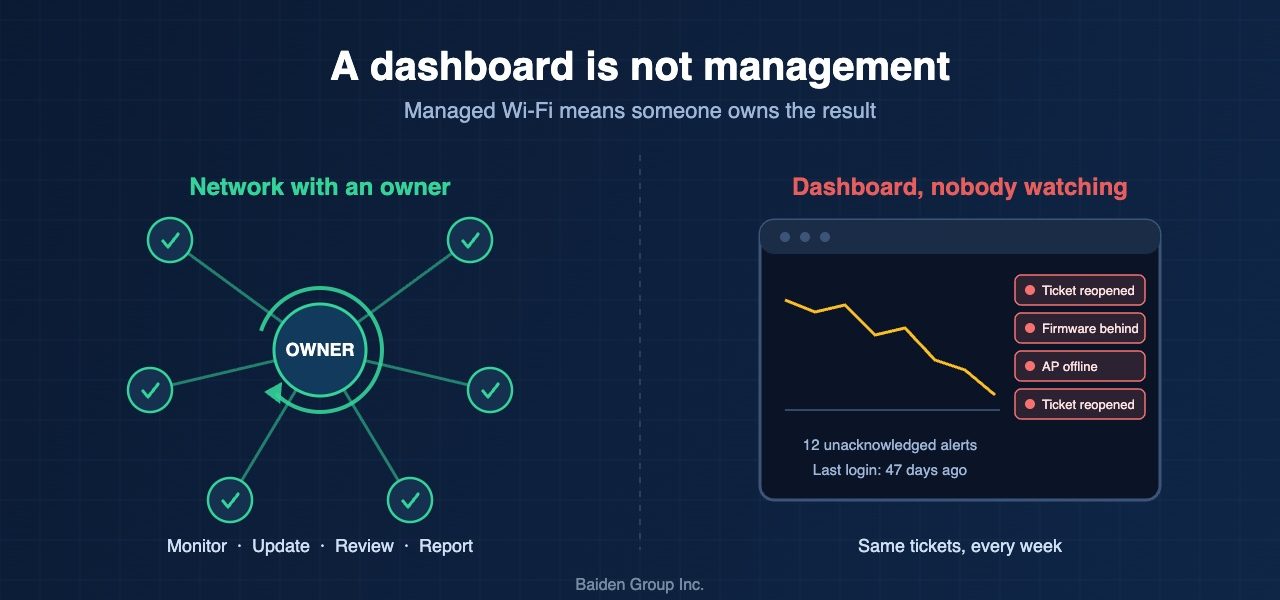
The tickets look familiar. A call drops in the same hallway. Scanners stall every afternoon. One meeting room works on Monday and fails on Thursday. Then someone reboots an access point, and the complaints quiet down for a week. After that, they come back. Meanwhile, firmware sits unpatched and a few extra access points have been added to “fix coverage.” Still, no one on the team would claim they own the wireless network.
That pattern is more common than most IT teams admit. A single install or health check can fix a known problem. However, it cannot watch the network as the building, the device mix, and the firmware change. That ongoing ownership is what managed Wi-Fi services actually provide.
What managed Wi-Fi actually is
Managed Wi-Fi is an ongoing service. A wireless specialist takes responsibility for the health and performance of your network. In practice, someone watches for degradation, applies updates, and deals with issues before they become a floor full of complaints.
It is not the same as a cloud dashboard. Platforms such as Cisco Meraki or Aruba Central make a network easier to see. However, they do not decide what to change, when to change it, or whether last month’s fix created a new problem. In short, a dashboard is a tool. Management is a person who uses it and is accountable for the result.
Similarly, it is not a repair contract or a vendor support ticket. Those start after something has already failed. Good managed Wi-Fi services start before that and stay in place after the issue is closed. Specifically, that means monitoring and alerting, current firmware and security, scheduled performance reviews, clear monthly reporting, and a specialist you can reach.
Signs your network needs ongoing management
You do not need a managed service just because you have Wi-Fi. Instead, you need it when the network matters to daily work and no one is truly looking after it.
Recurring complaints. If the same hallway or time of day keeps reaching the helpdesk, the last fix missed the root cause. Reboots and extra access points can hide the cause for a while. They rarely end it.
No one owns the network. It may sit with a generalist IT team, a general MSP, or an installer who left long ago. As a result, changes get made under pressure and never documented. When something breaks, the first hour goes to figuring out who changed what.
The site is growing. Headcount rises, or another floor comes into use. Access points get added, but the channel plan is not revisited. I have walked sites where every new complaint was answered with another access point. Eventually, several radios were audible from a single spot on the floor. The coverage map looked better. The interference was worse.
Firmware and security drift. Controllers fall behind on recommended releases. Meanwhile, SSIDs pick up exceptions that no longer match your policy. None of this shows up in a signal strength check.
What to ask a managed Wi-Fi provider
Ask questions that show how the service will actually run. For example, who is watching the network, and what happens when it degrades? If the only answer is dashboard access, you are still doing the management yourself.
Next, ask whether they know your platform. A vendor neutral provider should work with Cisco, Aruba, Ruckus, Juniper Mist, Meraki, or a mix. Also, ask for a sample report. It should name findings and recommended actions, not just display charts.
In addition, ask whether they will measure the network before taking it on. A baseline survey or focused health check should come first. Finally, ask what happens if you leave. You should keep access to your controllers, documentation, and configuration.
When a single survey or health check is enough
Managed Wi-Fi is not the right starting point for every site. For instance, a health check fits when complaints have just started or a single area is failing. Likewise, an RF site survey fits when you are validating a new install or measuring again after a layout change.
If those engagements close the issue, you may not need a managed service. On the other hand, if the same problems return and no one owns the follow through, ongoing management is the more honest answer.
At Baiden Group, we offer Wi-Fi design, RF site surveys, troubleshooting, and managed Wi-Fi for Canadian organizations. Whether you need a single health check or ongoing ownership, we start by measuring the network you actually have.
Have questions about how these developments affect your network? Reach out to the Baiden Group team.