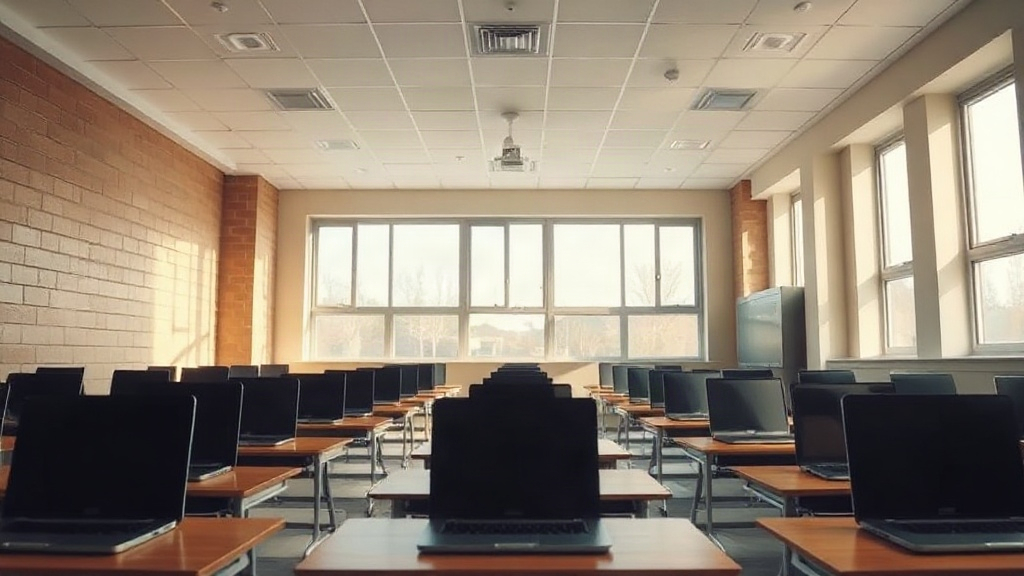
Schools look simple from the parking lot. However, a school building is one of the hardest wireless environments I survey. Classrooms pack thirty devices into one small room. Meanwhile, the walls are often cinderblock, which chews through signal. For this reason, school Wi-Fi design fails whenever a team copies an office plan onto a floor plan.
Density is the real problem, not coverage
Most school complaints get blamed on weak coverage. In practice, coverage is rarely the issue. A modern access point throws plenty of signal down a hallway. Instead, the failure shows up as capacity. When a class of thirty students opens laptops at the same moment, they all hit one cell.
Furthermore, a single access point in a corridor cannot serve four packed classrooms at once. That layout looks tidy on a drawing. However, it starves every room at the busy times. For this reason, I design classroom by classroom, and I often place an access point inside each room rather than in the hallway.
Building materials that punish RF
Schools are built to last, and that construction fights wireless. Cinderblock, poured concrete, and steel lockers all attenuate signal. Moreover, older buildings hide plaster walls with metal lath, which acts like a screen against RF. A predictive design that assumes drywall will promise coverage that never appears on site.
Additionally, many gyms and cafeterias have hard reflective surfaces and high ceilings. Consequently, signal bounces and multipath climbs. For this reason, I validate every school design with a real on site survey, not a floor plan and an assumption.
Test days, device programs, and roaming
The load in a school is not steady. Notably, a provincial testing day drives every device onto the network within the same hour. Similarly, a one to one laptop or tablet program pushes device counts far past what older networks were sized for. Generally, a building planned five years ago was never built for this demand.
Roaming adds another wrinkle. Students and staff move constantly between rooms, halls, and shared spaces. However, many school laptops are cheap and roam poorly, so they cling to a distant access point long after a closer one appears. As a result, performance drops even when coverage looks fine on paper. In practice, tuning cell size and steering those clients fixes far more than adding hardware.
In addition, a school carries more than laptops on the air. Interactive displays, security cameras, door sensors, and phones all share the same spectrum. Therefore, channel planning and airtime management matter as much as raw coverage. In fact, raising the minimum data rate keeps slow far devices from starving a busy classroom cell.
Guest and student traffic also need separation. Specifically, staff systems, student devices, and building sensors should not share one flat network. Otherwise, a single compromised laptop can reach systems it has no business touching. In practice, I split these onto separate networks with their own security, then size each one for its real device count.
What good design gets right
Canadian schools face all of this on tight budgets and short summer windows. Ultimately, the work has to be right the first time, because a failed network on the first day of testing becomes a public problem. For this reason, good school Wi-Fi starts with a proper RF site survey, accounts for the walls and the crowds, and plans for peak load rather than an empty building. That is exactly the work Baiden Group does, from Wi-Fi design and RF site surveys to troubleshooting and managed Wi-Fi.
Have questions about how these developments affect your network? Reach out to the Baiden Group team.