I have walked hundreds of buildings with a survey kit on my back. Most of the time, someone calls me in after another team already ran a survey. Often that report looked clean on paper. However, the network still dropped calls and stalled scanners in the field. That gap between the report and the reality is what I want to explain today.
A survey is only as good as the conditions it captures
An RF site survey is a snapshot of one building at one moment. Therefore the conditions during the survey matter as much as the readings. For example, an empty warehouse behaves nothing like a full one. Bodies, water, metal racking, and stacked inventory all absorb signal. Consequently a survey run in an empty space paints a picture that never matches production.
Similarly, doors matter. A fire door that sits open during the walk will sit closed during a shift. In practice that single door can drop a client by 15 dB. Notably, most weak surveys ignore this entirely. They capture a best case and call it done.
Coverage is not the same as capacity
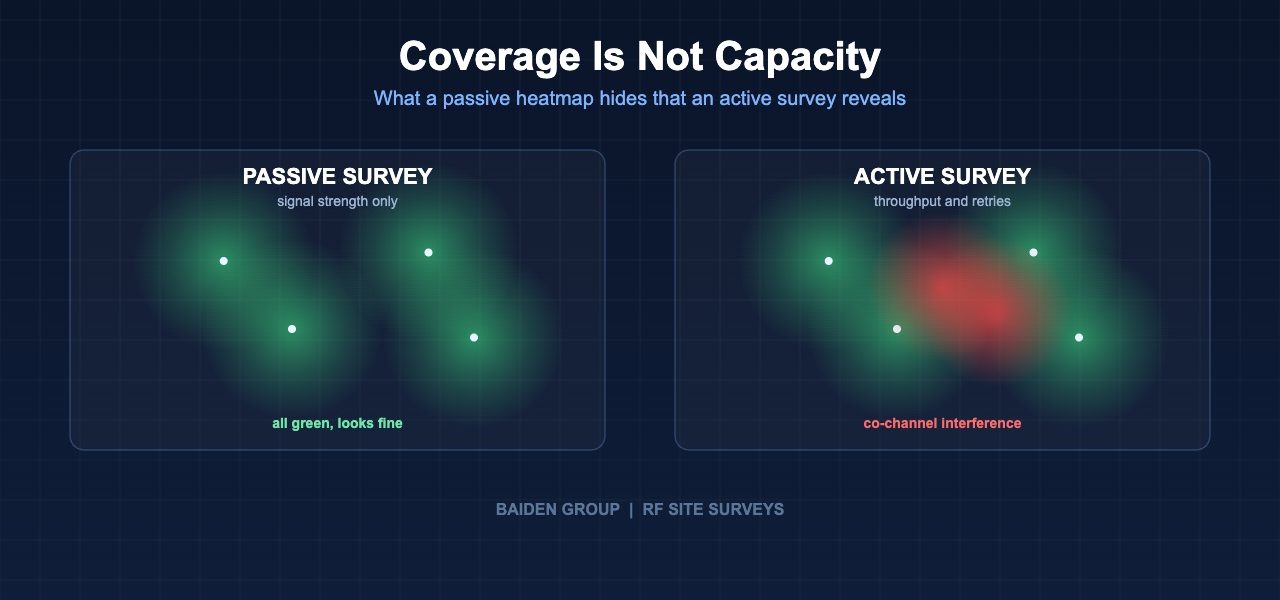
Most survey reports lead with a coverage heatmap. Green everywhere looks reassuring. However, coverage only tells you that a signal exists. It says nothing about how many devices that signal can actually serve.
For instance, a hospital floor might show strong RSSI in every room. Meanwhile 40 infusion pumps, a dozen tablets, and staff phones all fight for the same channel. As a result the users see a full signal bar and a dead application. Capacity planning fixes this, yet a surprising number of surveys skip it. Specifically they never model client count, airtime, or channel reuse.
The passive survey is where most reports stop
A passive survey listens to what the access points broadcast. It maps signal strength, and it is fast. Additionally it is the easy part. That is exactly why weak surveys stop there.
An active survey is the harder work. Here the kit associates to the network like a real client. Then it measures throughput, retransmissions, and roaming behavior as you walk. In testing, this is where the ugly truth shows up. For example, a client can sit at minus 60 dBm and still crawl because of co-channel interference two floors away. A passive map will never reveal that. Conversely an active survey catches it immediately.
When you should re-survey
A survey has a shelf life. Generally I tell clients to re-survey after any change that alters the RF environment. New racking, a wall build-out, a tenant fit-up, or a device refresh all qualify. Moreover a firmware change on the controller can shift transmit power across every access point overnight.
In short, treat the survey as a living document, not a one-time certificate. On the other hand, a design validated two years ago against a warehouse that has since doubled its inventory is not a design at all. It is a guess.
What good work looks like
A strong survey states its conditions plainly. Furthermore it separates coverage from capacity. It includes active measurements, not just a pretty heatmap. Ultimately it tells you what to change and why, in language your team can act on.
At Baiden Group we run RF site surveys, network design, troubleshooting, and managed Wi-Fi for enterprise environments across Canada. We survey the building you actually run, under the conditions you actually run it. Have questions about how these developments affect your network? Reach out to the Baiden Group team.