I have been doing RF site surveys since before most enterprise APs had MIMO antennas. In that time, I have seen every version of what vendors and installers call a “survey.” However, most of what passes for a site survey is not a survey at all. It is a walk-through with a clipboard and a rough floor plan.
That matters because the survey drives everything downstream. Therefore, if the survey is wrong, the design is wrong. If the design is wrong, you end up with coverage gaps, roaming problems, and a post-installation finger-pointing exercise that nobody wins.
What a Real Survey Actually Involves
A proper passive survey means walking the entire coverage area with Ekahau AI Pro running on a validated adapter, mapping signal levels, noise floors, and co-channel interference throughout the space. Specifically, this means every aisle in a warehouse, every patient room in a hospital, every classroom in a school. There are no shortcuts.
Furthermore, a passive survey captures what is already in the RF environment. You document existing APs, neighboring signals, interference sources, and physical obstructions. In industrial environments, I also look for high-bay metal racking, automated equipment, and concrete reinforcement. Additionally, I check for microwave ovens, cordless phones, and older 2.4 GHz devices that will degrade 802.11 performance no matter how good the new infrastructure is.
For design surveys, the process goes further. In this phase, I do an AP-on-a-stick validation. I mount a real AP at a proposed height and location, then walk the coverage area to measure actual signal propagation before committing to the final design. This step is especially important in environments with unusual building materials or high ceilings where propagation models do not hold.
What Bad Surveys Miss
Most incomplete surveys miss three things consistently. First, they do not walk the whole space. The surveyor does main corridors and maybe a sample room or two, then extrapolates. That approach fails in environments where materials vary significantly from room to room.
Second, they do not document the noise floor. Consequently, when the new APs go in and clients still complain about performance, nobody has a baseline to compare against. You cannot troubleshoot what you never measured.
Third, they ignore client perspective. Notably, most surveyors measure only from the AP looking out. However, what actually matters is what the client device sees. A strong AP signal does not guarantee a strong return path from a mobile device or a handheld scanner. Moreover, client-side measurements reveal SNR problems that AP-side measurements mask completely.
How to Evaluate Survey Quality
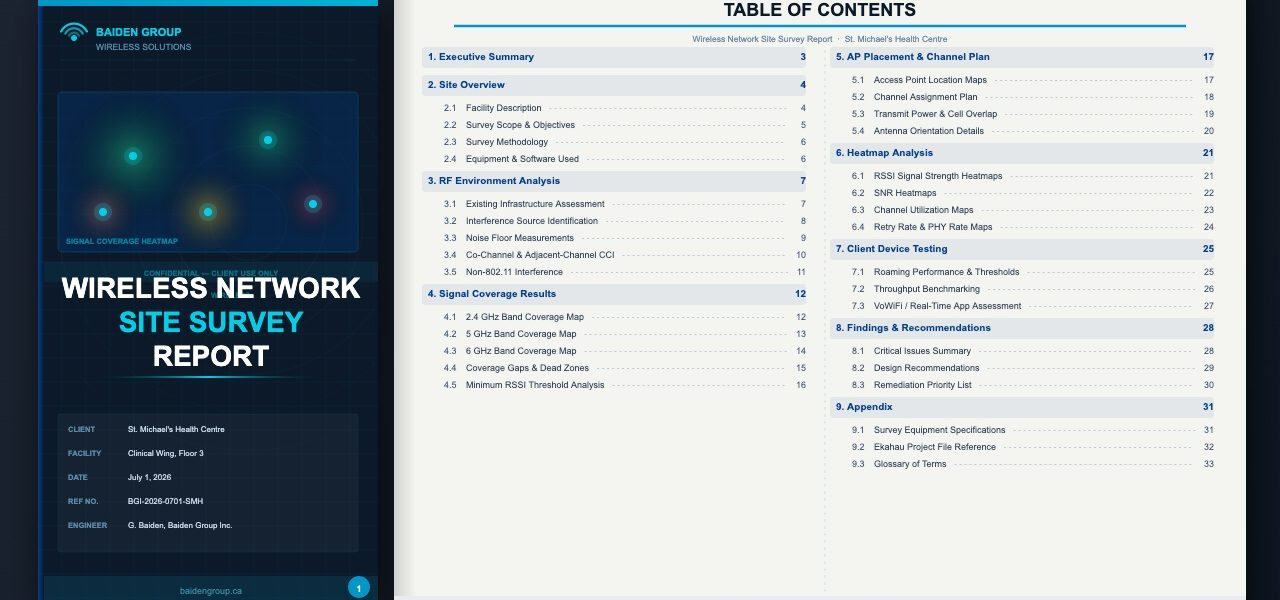
When reviewing a survey deliverable, I look for specific things. A credible survey includes heatmaps showing signal strength, noise floor, and SNR across the entire coverage area. Furthermore, it includes a channel plan with interference analysis. Additionally, it identifies AP placement by height, mounting type, and antenna orientation. It does not just show dots on a floor plan.
A good deliverable also tells you what the surveyor found, not just where they walked. For example, if there is a transformer room causing interference on channels 1 and 6, that should appear in the findings with a recommendation. Similarly, if the existing infrastructure has APs placed too close together and causing co-channel interference, the survey should flag it.
Importantly, the survey report should be specific enough that someone else could use it to validate the design independently. If it is not specific, it is marketing material.
When to Re-Survey
Environments change. Therefore, a survey that was accurate three years ago may not reflect the current reality. In my experience, enterprise environments need a re-survey whenever there is a significant physical change. Specifically, that includes major renovations, new high-density equipment deployments, new medical devices, or a shift in client device mix.
Additionally, any post-installation complaint about coverage, roaming, or throughput should trigger at minimum a targeted active survey of the problem area. In many cases, the original design assumptions are still valid, but interference sources have changed. A fresh look catches these changes quickly.
Overall, the survey is not a box to check on the project timeline. It is the foundation the entire deployment rests on. Get it wrong, and you will spend years troubleshooting symptoms of a problem that should have been caught at the start.
Have questions about how these developments affect your network? Reach out to the Baiden Group team.