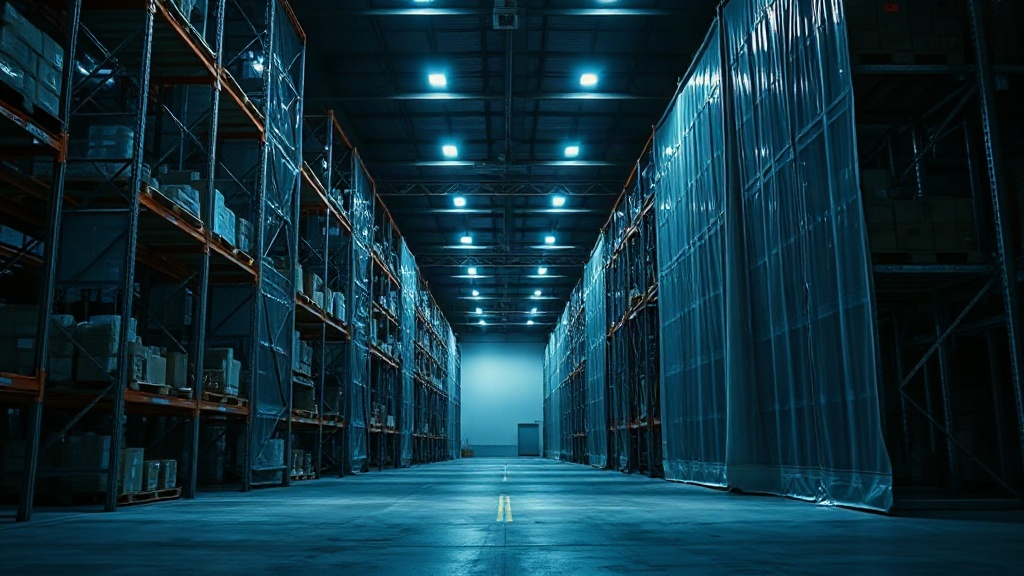
I got the call on a Tuesday morning. A distribution centre in Milton had scanners dropping mid shift, and nobody could explain why the problem only showed up after dark. The warehouse had been running for six weeks already. Consequently, the operations team was losing patience fast.
The Problem: Scanners Dropping Mid Shift
Pickers were losing their handheld scanners roughly every twenty minutes. Each drop forced a fresh login and cost the picker a minute or two. Over a shift, that adds up to real productivity loss. Specifically, the drops clustered near the cold storage dock at the north end of the building. Importantly, that corner had tested clean on the original predictive survey. The site’s IT manager pointed this out right away. He assumed the network hardware was faulty. Instead, I suspected something the survey never accounted for.
What the Original Survey Missed
A warehouse Wi-Fi survey is only useful if it reflects real conditions. Most predictive surveys model a building using its floor plan and construction materials. However, they rarely model the building at full operational capacity. This warehouse was surveyed empty, before racking went in and before a single pallet arrived. In practice, an empty warehouse and a fully loaded one behave like two different buildings on radio frequency. Steel racking reflects and absorbs signal. Stacked product, especially anything with high water content or metal packaging, does the same. As a result, the predictive model underestimated attenuation in the cold storage aisles, where racks sat close together and inventory turned over fast.
Diagnosing It on Site
I walked the floor with a spectrum analyzer and a laptop running live signal capture. Meanwhile, I asked a supervisor to run a normal overnight pick cycle so I could see real conditions. Sure enough, signal strength in the cold storage aisles dropped by nearly 15 dB once the racks filled with product. That drop pushed several access points below a usable signal to noise ratio for the handhelds. For this reason, the scanners kept dropping their connection and reassociating with a distant access point, which made the problem worse. Additionally, the cold storage curtains turned out to be lined with a foil layer, which nobody had flagged during design.
What We Changed
We added two access points inside the cold storage zone and adjusted mounting height on three existing ones. Furthermore, we tuned the roaming thresholds so handhelds released a weak connection sooner instead of clinging to it. In testing, we ran two full overnight shifts with the warehouse back at normal capacity. Notably, the scanner drops disappeared entirely once the changes went live. The client asked one simple question afterward. Why had nobody caught this before deployment?
This kind of gap shows up more often than most IT directors expect. Warehouses rarely stay empty for long, and cold storage areas keep expanding as more operators handle temperature sensitive freight. Similarly, distribution centres often add automation or denser racking after their initial fit out. Each change alters the building’s RF environment, often without anyone flagging the design for review. On the other hand, a network validated only once, at handover, has no way to catch that drift later. For this reason, we recommend a fresh survey whenever a facility changes its racking layout, adds cold storage, or shifts to a busier pick profile. Canadian fulfillment operators are expanding these zones quickly right now, and the network plan needs to keep pace with them.
The honest answer is that a survey done under the wrong conditions gives a confident, clean, and wrong picture. In summary, a coverage plan is only as good as the conditions it was tested under. That is why Baiden Group validates designs against real operational conditions whenever a project allows it. We do not settle for modeling an empty shell of a building. Our RF site surveys, Wi-Fi designs, and troubleshooting work all start from one principle. We measure the building as it actually operates, not as it looks on the day it opens.
Have questions about how these developments affect your network? Reach out to the Baiden Group team.