Most IT directors do not track IEEE working group meetings. That is understandable. However, the pace of the IEEE 802.11bn Wi-Fi 8 standard will shape enterprise equipment budgets for years to come. In practice, procurement decisions made today depend on understanding where this standard actually stands, not where marketing slides claim it stands.
Where 802.11bn Stands Right Now
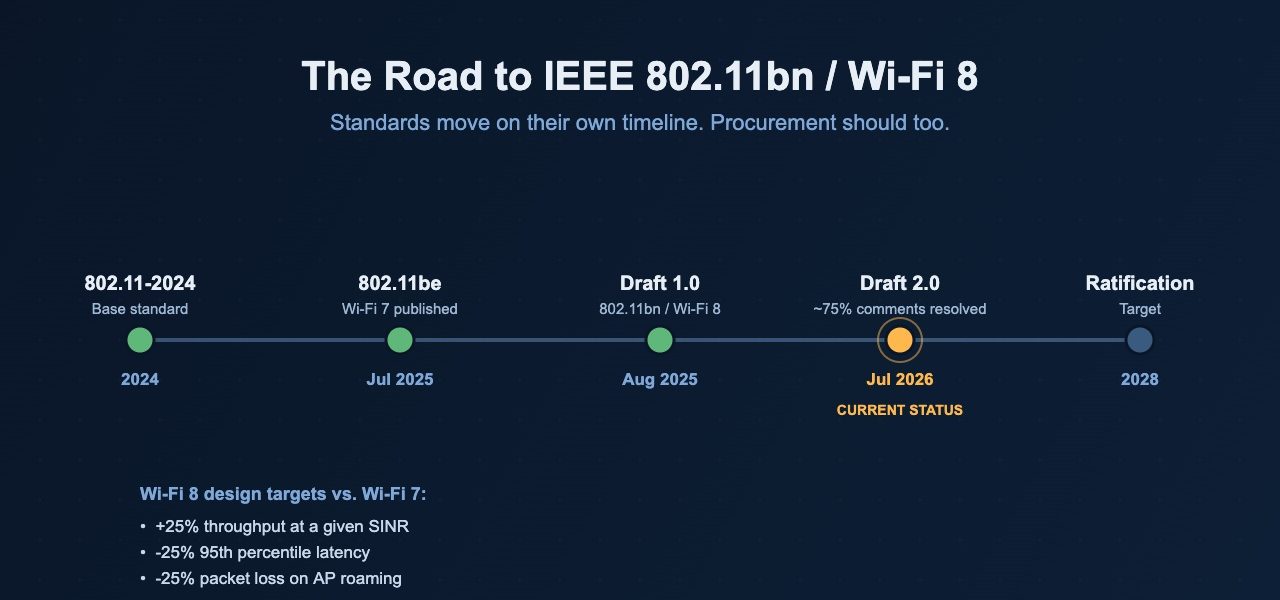
IEEE 802.11bn reached Draft 1.0 in August 2025. Since then, the task group has worked through comment resolution on that draft. As of the May 2026 interim session, roughly 75 percent of comments on Draft 1.0 have been resolved. Consequently, Draft 2.0 has slipped from its original May 2026 target to July 2026. That said, the core features of the standard are largely locked in at this point. Most of the remaining work involves edge cases and interactions between features, not fundamental design questions. Final ratification is currently targeted for 2028.
This timeline matters because it follows closely behind 802.11be, the amendment that underpins Wi-Fi 7. That amendment was published in July 2025, and the base 802.11-2024 standard was released the year before. In other words, the industry is still absorbing Wi-Fi 7 while Wi-Fi 8 works its way through draft ballots. That overlap is normal. Indeed, it has happened with every generation before this one.
Reliability, Not Just Speed
Wi-Fi 7 sold itself on raw throughput. Wi-Fi 8 takes a different approach. Its stated goals include a 25 percent throughput increase at a given signal to interference and noise ratio. It also targets a 25 percent cut in 95th percentile latency and a 25 percent drop in packet loss during roaming between access points. For hospitals, warehouses, and campuses running mission critical applications, that reliability focus matters more than another speed bump on a spec sheet.
Additionally, it reflects what I actually see in the field. Most clients do not need more raw bandwidth. Instead, they need a network that does not drop packets when a handheld scanner or a nurse’s workstation on wheels roams between access points. Notably, the working group calls this focus Ultra High Reliability, and that name is deliberate. It signals a shift away from chasing bigger numbers toward fixing the problems that actually show up in day to day operations.
Why the Standards Process Matters for Procurement
IEEE standards move slowly by design. Multiple vendors, competing interests, and years of comment resolution stand between a draft and a ratified standard. For this reason, chasing draft hardware early is a gamble. Vendors sometimes ship pre-standard products based on early drafts, and those products do not always align with what eventually gets ratified.
In contrast, waiting for full ratification means missing early performance gains that are already stable and safe to deploy in practice. The right approach sits between those two extremes. Specifically, it means tracking which features are locked in a draft versus still under active debate. It also means buying hardware built on chipsets with a clear upgrade path. Meanwhile, procurement teams should treat vendor claims about “Wi-Fi 8 ready” hardware with some skepticism until Draft 2.0 stabilizes later this year.
What This Means for Canadian IT Teams
Wi-Fi 8 hardware realistically will not appear on serious procurement lists until 2027 or later. In the meantime, most enterprise networks across Canada are still working through Wi-Fi 6E or Wi-Fi 7 deployments. Overall, that is the right priority for nearly every organization I work with. Getting the current generation right matters more than waiting on a future standard. That means a proper RF site survey and a design based on real device density.
Similarly, a network that is poorly designed today will not be fixed by a new IEEE amendment three years from now. Therefore, the smartest move for most Canadian IT teams is to build a solid foundation now. That foundation should be modular enough to absorb Wi-Fi 8 hardware when it actually ships and is actually certified.
Standards timelines make good headlines. However, they do not replace a solid RF site survey, a design built around your actual environment, and ongoing management once the network is live. At Baiden Group, that is where we spend most of our time. We help clients build networks on solid fundamentals now. In practice, that means Wi-Fi design, RF site surveys, troubleshooting, and managed Wi-Fi, so they are ready for whatever Wi-Fi 8 eventually delivers.
Have questions about how these developments affect your network? Reach out to the Baiden Group team.