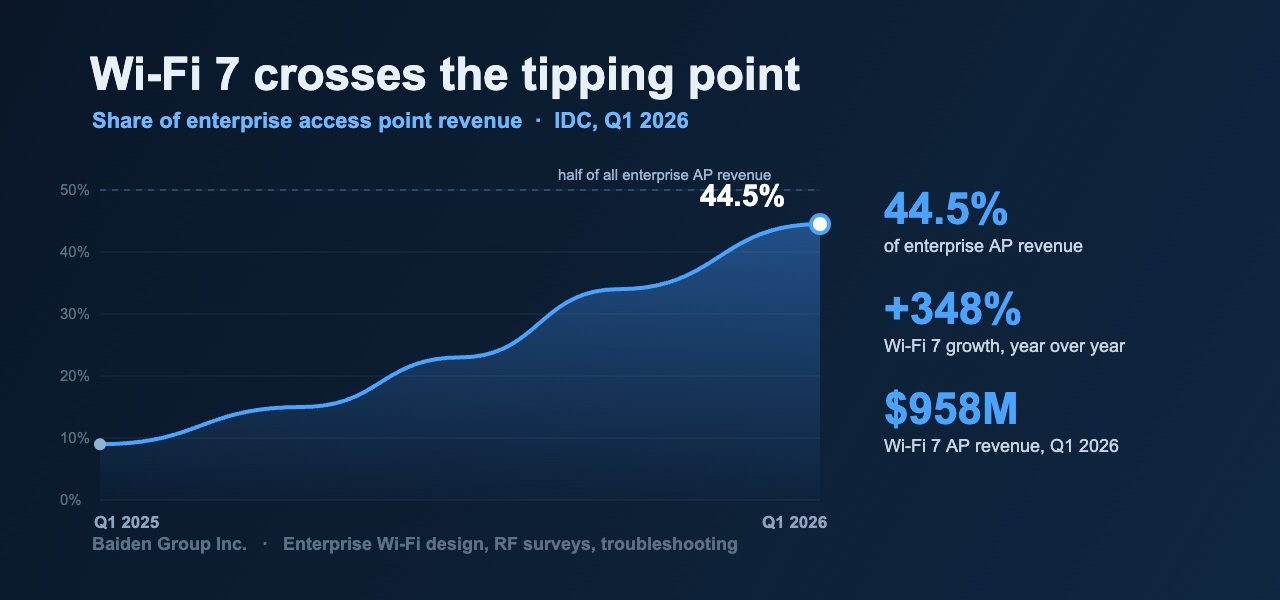
Wi-Fi 7 enterprise adoption just passed a real milestone. The technology now makes up nearly half of all access point spending worldwide. IDC published the first quarter 2026 figures, and the trend is impossible to ignore. In short, Wi-Fi 7 went from niche to mainstream in about a year. For a working field specialist, that speed is worth a closer look.
The numbers tell a clear story
The worldwide enterprise wireless market reached 2.7 billion dollars in the first quarter of 2026. That figure is up 15.9 percent from the same quarter last year. Notably, Wi-Fi 7 access points brought in 958 million dollars of that total. As a result, the standard now accounts for 44.5 percent of dependent access point revenue.
Consider where this segment sat only one year ago. In the first quarter of 2025, Wi-Fi 7 pulled in just 214 million dollars. Consequently, the year over year jump lands at a remarkable 348 percent. For context, no recent Wi-Fi generation climbed the adoption curve this fast. Clearly enterprises are done waiting for the standard to settle.
What is actually driving the shift
Multi-Link Operation is the real headline feature behind these numbers. In practice, MLO lets a single client use two bands at the same time. Therefore latency drops and reliability climbs, which matters for voice, video, and dense IoT floors. Additionally, AI heavy workloads punish any network that stutters under load. In fact, dropped packets on a busy factory floor can stall a whole production line.
Vendors have noticed the same demand, and they keep shipping high density hardware. Cambium, for example, launched its X7-56X access point on July 22. Moreover, that unit claims support for up to 1,280 clients on a single radio. Meanwhile the HPE and Juniper merger keeps folding Aruba campus gear into Mist AI management. Cisco still leads the market, yet the combined HPE lineup posted the fastest growth among the top vendors.
The Canadian angle matters here
Here is the part Canadian IT teams should watch closely. ISED opened the entire 6 GHz band for licence exempt use across the country. Consequently, Wi-Fi 7 can spread traffic across three bands in Canada rather than two. In fact, roughly 13.7 percent of Canadian Wi-Fi traffic already runs on 6 GHz.
That clean spectrum is a big reason the standard performs so well up north. However, open spectrum on its own does not fix a network. Furthermore, a fast access point in the wrong location still leaves dead zones and frustrated users. For that reason, the hardware is only ever half the job.
What I tell clients to do about it
Do not rip out working gear just because a market chart moved. Instead, start every refresh with a proper RF site survey. Specifically, measure your real coverage, interference, and client density before you sign a purchase order. In my experience, that single step saves more money than any vendor discount ever will.
Then match the hardware to the actual problem in the actual building. For instance, a warehouse with steel racking needs different placement than a quiet hospital ward. Similarly, a school gym and an open office pull on the network in very different ways. Moreover, ceiling height and wall material change everything about real coverage. Ultimately, Wi-Fi 7 rewards careful design and exposes lazy design, exactly like every generation before it.
The market data is loud, and the spectrum is finally wide open. Still, the fundamentals of good wireless have not changed one bit. Plan the coverage, survey the site, and buy for the room you actually have. Have questions about how these developments affect your network? Reach out to the Baiden Group team.