Most Wi-Fi 7 coverage focuses on wide channels and headline speeds. However, most devices on an enterprise network never use either. Sensors, badges, scanners and building controllers live on narrow 20 MHz channels. In January 2026, the Wi-Fi Alliance added a Wi-Fi CERTIFIED 7 option for client devices that operate only on 20 MHz channels. For many IT teams, that change matters more than another speed record.
What the 20 MHz certification actually covers
The new option lets small client devices carry Wi-Fi 7 features without supporting wide channels. According to the Wi-Fi Alliance, those features include Multi-Link Operation, 4K QAM, downlink and uplink MU-MIMO, and Multi-RU. In addition, the Alliance points to lower power draw, simpler device designs and more reliable connections in dense deployments.
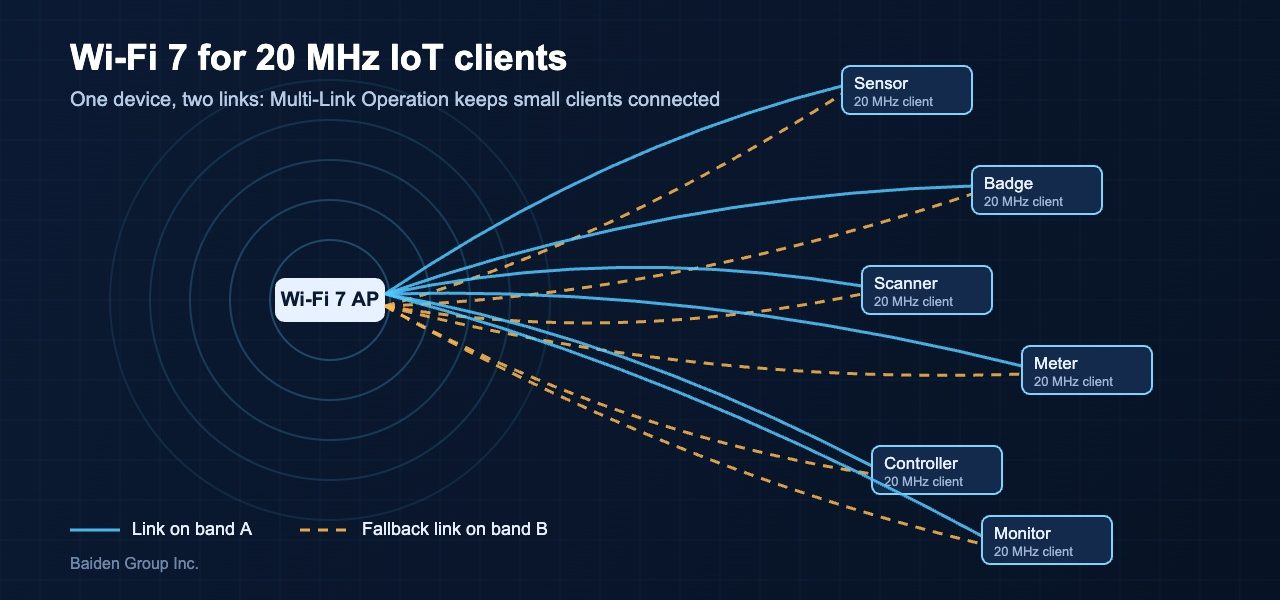
Specifically, Multi-Link Operation is the feature to watch. A sensor that can hold links on two bands has a fallback when one band gets busy. For example, a temperature monitor in a pharmacy fridge could keep reporting while one band is congested. Multi-RU and MU-MIMO matter too. Both help an access point serve many small clients more efficiently in the same airtime.
That said, certification is an option, not a mandate. Device makers decide whether to pursue it. Consequently, you will see a mix of Wi-Fi 4, Wi-Fi 6 and Wi-Fi 7 IoT clients on the same network for years.
Why this matters for enterprise buying decisions
Wi-Fi 7 access points are already mainstream. IDC reported that Wi-Fi 7 reached 44.5% of enterprise dependent access point revenue in the first quarter of 2026. A year earlier, that share was 11.8%. In other words, many Canadian organizations are buying Wi-Fi 7 infrastructure right now.
Until recently, the IoT client side lagged behind. Laptops and phones gained Wi-Fi 7 first. Meanwhile, the long tail of sensors and handhelds stayed on older standards. The 20 MHz option gives that long tail a path forward. As a result, the benefits of a Wi-Fi 7 refresh can eventually reach the devices that make up most of your client count.
Nevertheless, timing still matters. IoT devices often stay in service far longer than laptops or phones. Therefore, the sensors you buy this year will shape your network well into the next decade. Asking vendors about Wi-Fi 7 certification now costs nothing. Discovering a gap after a large rollout costs a great deal.
What to ask before your next IoT purchase
Start with the certification itself. Ask whether the device is Wi-Fi CERTIFIED 7 and which features it supports. Not every certified device will implement every optional feature. For instance, confirm whether Multi-Link Operation is supported, and on which bands.
Next, check band support. A device that supports 6 GHz gives you cleaner spectrum in most Canadian buildings. In contrast, a device limited to 2.4 GHz will still compete with legacy clients and neighbouring networks. Also, confirm the security posture. Find out whether the device supports WPA3 and how it handles certificate based authentication.
Finally, test before you scale. Put a handful of devices on your production network and watch roaming, battery life and retry rates. Lab results rarely match a busy clinic floor or a warehouse full of metal racking. In practice, a short pilot reveals problems while they are still cheap to fix.
Planning the network around mixed clients
Overall, your design must serve old and new clients at the same time. Legacy IoT devices will stay on 2.4 GHz for years. Meanwhile, new Wi-Fi 7 clients will spread across 5 GHz and 6 GHz. Good channel planning, sensible SSID design and accurate RF surveys keep both groups working well. Importantly, the plan should reflect the clients you actually run, not only the newest ones on the spec sheet.
At Baiden Group, we help Canadian organizations plan for exactly this kind of transition. Our Wi-Fi design and RF site survey work accounts for every client type on your network, not just the newest laptops. We also handle troubleshooting in mixed environments and provide managed Wi-Fi for teams that want ongoing ownership. In short, the right plan today saves a costly redesign later.
Have questions about how these developments affect your network? Reach out to the Baiden Group team.