Wi-Fi 7 has been sold on paper specs for two years now. Vendors point to wider channels and higher theoretical throughput. However, one Wi-Fi 7 feature just moved from marketing slide to verified field data. It matters more than any headline speed number.
That feature is Multi-Link Operation, or MLO. In March 2026, the Wireless Broadband Alliance published new Wi-Fi 7 MLO trial data built with AT&T, RUCKUS Networks, and Intel. The results give IT teams something they rarely get before a refresh decision: real performance data instead of lab claims.
What Multi-Link Operation Actually Does
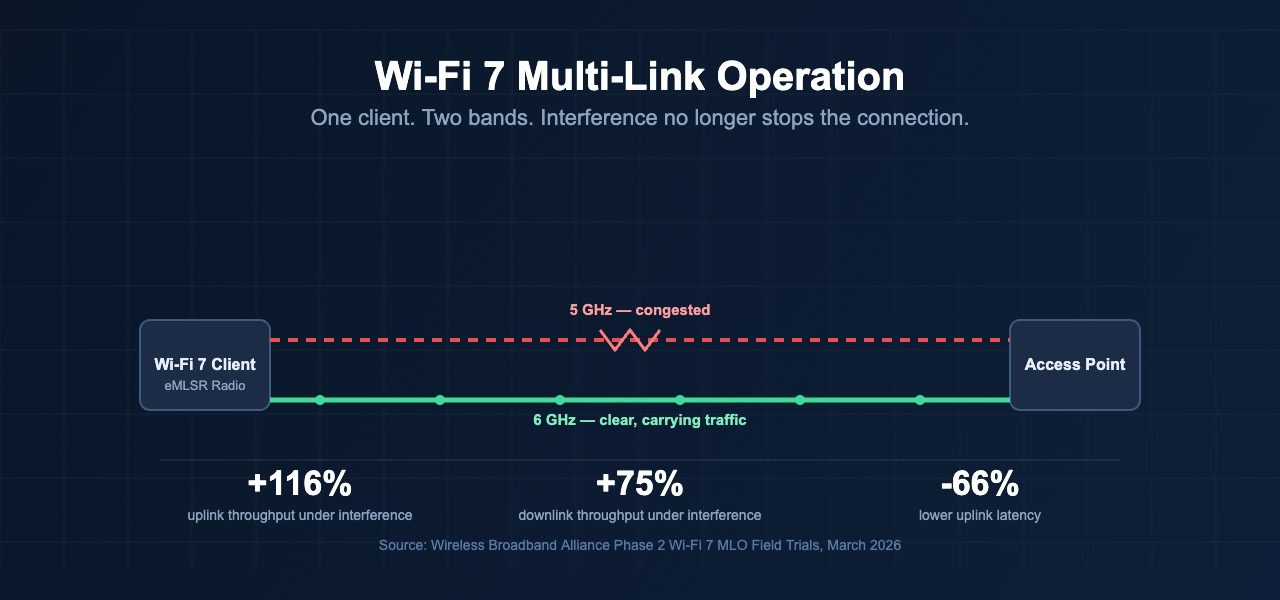
MLO lets a single Wi-Fi 7 client maintain simultaneous links across multiple bands, typically 5 GHz and 6 GHz. Traditional Wi-Fi picks one band and sticks with it until roaming forces a switch. Consequently, a client stuck on a congested 5 GHz channel just suffers until it hands off to a new access point.
With MLO, the client steers around interference in near real time. Specifically, the trial tested enhanced Multi-Link Single Radio mode, known as eMLSR. This lets one radio hop between bands instead of running two separate radios at once. For enterprise IT teams, that means lower device cost and lower power draw without giving up the resilience of a multi band connection.
The Numbers From The Field Trials
The trial paired RUCKUS Wi-Fi 7 access points with Intel BE200 based clients running eMLSR. Under interference, uplink throughput improved by up to 116 percent. Latency on real time uplink traffic dropped by up to 66 percent.
Similarly, downlink numbers followed the same pattern. Under co channel interference, downlink throughput improved by up to 75 percent. One way latency dropped by up to 44 percent. In clean spectrum conditions, throughput gains reached 42 percent downlink and 139 percent uplink.
These are not lab bench numbers pulled from a single test run. Importantly, this was a live field trial. A major carrier, a major access point vendor, and a major chipset vendor all validated the same results together.
What This Means For A Wi-Fi 7 Refresh
Most Wi-Fi 7 access points from Cisco, HPE Aruba, and Juniper Mist already support eMLSR. Meanwhile, client support has caught up fast. Indeed, flagship phones from Samsung and Apple support MLO natively, and laptops running Snapdragon X Elite or Intel Core Ultra chips do too.
Additionally, Windows 11 Enterprise added native Wi-Fi 7 support in September 2025. As a result, most corporate laptop fleets bought after that date can already use MLO once the network side supports it.
That said, chipset marketing alone should not drive a refresh decision. In practice, MLO gains show up most where real interference already exists. Dense access point deployments, high client counts, and shared spectrum with neighboring tenants all qualify. A quiet single tenant office with light usage will not see anything close to a 116 percent uplink jump.
How Baiden Group Fits In
Before recommending a Wi-Fi 7 refresh to any client, I check whether their environment actually has the interference problem MLO solves. In fact, an RF site survey answers that question with data, not guesswork. Therefore, the survey comes before the purchase order, not after.
Baiden Group handles Wi-Fi design, RF site surveys, troubleshooting, and managed Wi-Fi for organizations across Canada. If your network already has co channel interference or dense access point deployments, an MLO capable refresh could deliver real gains. If it does not, spend that budget elsewhere instead.
Overall, MLO is one of the few Wi-Fi 7 claims that now has independent field data behind it. A vendor slide deck cannot tell you whether your building has the co channel congestion this feature actually fixes. A proper RF survey can. That is the difference between buying hardware because it is new and buying hardware because your network needs it.
Have questions about how these developments affect your network? Reach out to the Baiden Group team.