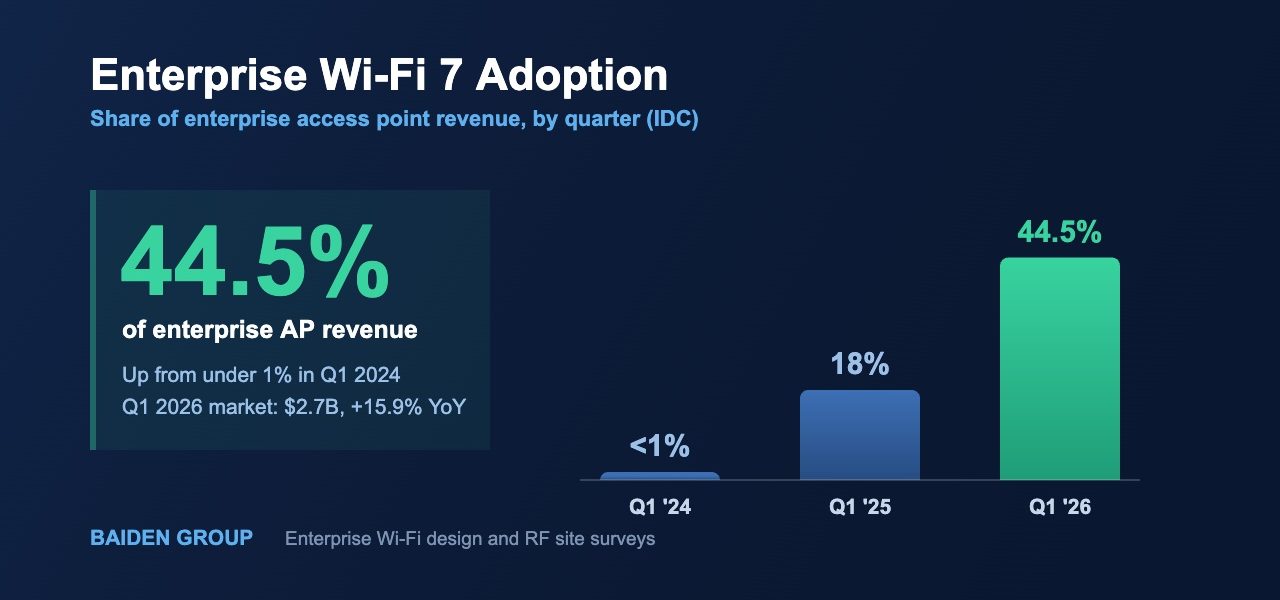
The Q1 2026 numbers are in, and they change how I talk to clients about refresh timing. Enterprise Wi-Fi 7 now accounts for 44.5% of dependent access point revenue. Notably, that same figure sat below 1% just two years ago. In short, this is the fastest standard ramp the industry has tracked, and it is happening faster than Wi-Fi 6 or 6E did.
The market grew, and Wi-Fi 7 drove it
IDC put the worldwide enterprise WLAN market at nearly $2.7 billion for the first quarter of 2026. That is 15.9% growth year over year. For context, most of that growth came from Wi-Fi 7 hardware replacing older gear. Cisco held the top spot with roughly $1.0 billion in revenue and 38.9% market share. Meanwhile, the broader field kept refreshing product lines to keep pace.
However, the headline number is not the point. The point is the slope. Wi-Fi 7 went from a rounding error to nearly half of AP revenue in a single year. Consequently, if your last refresh landed on Wi-Fi 6 in 2022 or 2023, you are now in the minority buying window, and prices on current-generation hardware tend to settle once volume ramps like this.
Consolidation is reshaping the vendor list
On July 1, Belden closed its $1.85 billion acquisition of RUCKUS Networks. For teams running RUCKUS gear, this matters. Additionally, the deal folds a large Wi-Fi, switching, and cloud management portfolio into a full-stack IT and OT vendor. RUCKUS serves more than 48,000 customers, so this is not a small shift.
I am not going to tell you a vendor acquisition is good or bad for your network. Instead, I will tell you what to watch. When ownership changes, roadmaps change. Support structures change. Licensing models sometimes change too. For example, Extreme Networks recently rolled out a new Wi-Fi 7 lineup alongside a simplified licensing model and third-party management for Cisco and HPE-Juniper gear. Therefore, if you are mid-contract with any of these vendors, ask your account team direct questions about roadmap continuity before you sign a multi-year renewal.
What the adoption curve actually means for you
Wi-Fi 7 is not just a speed bump. Specifically, the feature that matters in enterprise settings is Multi-Link Operation. MLO lets a client use multiple bands at once, which cuts latency and improves reliability under load. In practice, that is the capability driving upgrades in dense environments. Warehouses, hospitals, and campuses with heavy IoT counts feel it first.
That said, a new standard does not fix a bad design. I have walked into buildings where seven access points were visible from the front entrance. In that case, more radios did not mean better coverage. It meant co-channel interference and roaming problems that no firmware update will solve. Similarly, buying Wi-Fi 7 will not rescue a network that was never surveyed properly in the first place.
Here is my read on timing. If your Wi-Fi 6 or 6E gear is still under warranty and performing, you do not need to rush. However, if you are planning capital for 2027, budget for Wi-Fi 7 now, because the installed base is refreshing and the pricing window is open. Above all, do not let a vendor talk you into a rip-and-replace without a current RF site survey. The survey tells you whether you have a coverage problem, a capacity problem, or a design problem. Each one calls for a different fix.
The practical takeaway
Overall, the Q1 2026 data confirms what the field has felt for a year. Wi-Fi 7 is now the default enterprise choice, not the early-adopter gamble. Ultimately, that is good news for buyers, because volume brings mature drivers, better client support, and more competitive pricing. Still, the standard is only half the equation. The other half is a design that matches your building, your device density, and your actual traffic.
At Baiden Group, we help Canadian IT teams cut through the vendor noise. We run RF site surveys, design Wi-Fi that fits the space instead of the sales pitch, and troubleshoot networks that were never right to begin with. Have questions about how these developments affect your network? Reach out to the Baiden Group team.