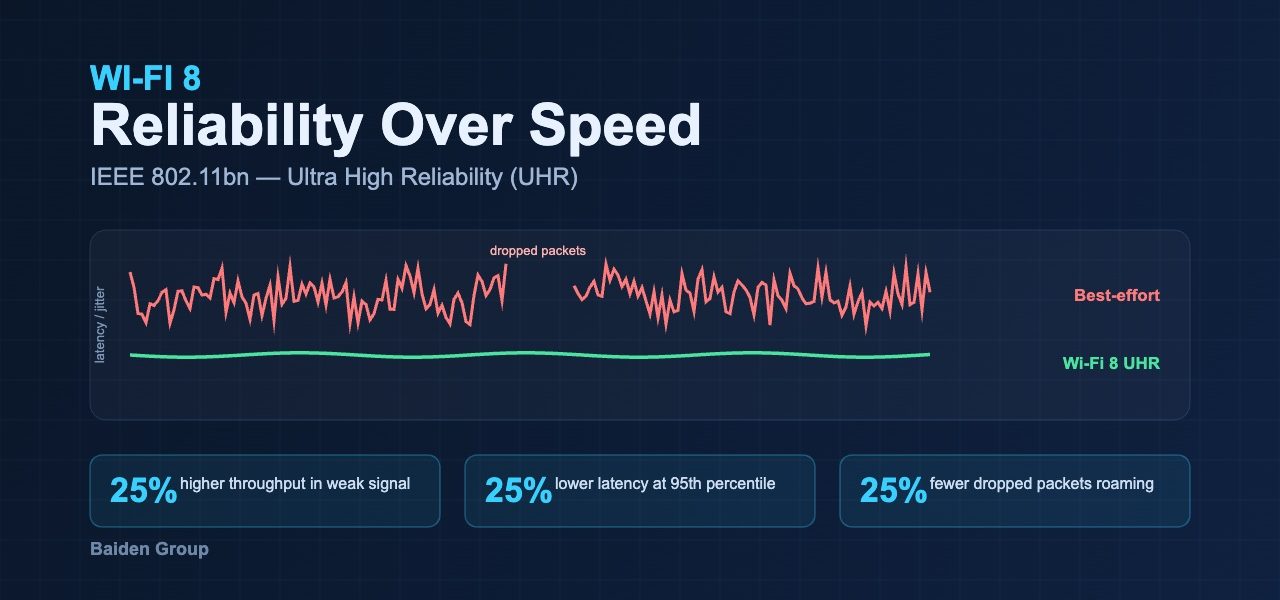
For the first time in a decade, a new Wi-Fi generation is not chasing a bigger speed number. Wi-Fi 8, the consumer name for the IEEE 802.11bn standard, holds the same peak data rate as Wi-Fi 7. Instead, it targets the thing that enterprise networks actually struggle with every day. That thing is reliability. At CES 2026, the show floor filled with early Wi-Fi 8 hardware, and the message from chip vendors stayed consistent. Notably, this is the core idea behind Wi-Fi 8 reliability. The standard fixes the problems users complain about, not the numbers that look good on a data sheet.
Reliability, not raw speed
The official name for 802.11bn is Ultra High Reliability, or UHR. That name tells you everything about the design goals. Specifically, the standard aims for 25 percent higher throughput in poor signal conditions, 25 percent lower latency at the 95th percentile, and 25 percent fewer dropped packets when a device roams between access points. Notice what is missing from that list. There is no new headline speed. In practice, most enterprise Wi-Fi problems are not speed problems anyway. They are coverage gaps, roaming stalls, and congestion in dense spaces. Therefore, a standard built around consistency solves more real complaints than another gigabit of theoretical throughput ever would.
What Multi-AP Coordination changes
The biggest technical shift in Wi-Fi 8 is Multi-AP Coordination, often shortened to MAPC. Traditionally, Wi-Fi treats each access point as an island. Each AP makes its own decisions and competes with its neighbors for airtime. Consequently, in a dense deployment the access points interfere with each other and clients suffer. MAPC changes that model. Instead, access points share timing, frequency, and spatial information so they cooperate rather than compete. As a result, a client near the edge of two cells gets coordinated service rather than a messy handoff. For warehouses, hospitals, and busy offices with many access points packed close together, this is the feature that matters most.
The timeline matters for buying decisions
Here is the part that gets lost in the CES excitement. The IEEE will not ratify 802.11bn until around 2028. Draft 1.0 was finalized in mid 2025, so the technical shape is fairly stable. However, early routers sold in 2026 run on prototype silicon. In other words, a Wi-Fi 8 label today is a bet on a draft, not a finished standard. Generally, I tell clients to treat first generation hardware on any new standard with caution. Interoperability and firmware maturity take time. Therefore, a rushed refresh to catch the newest logo rarely pays off.
What Canadian IT teams should do now
You do not need to wait for Wi-Fi 8 to fix reliability. In fact, most of the gains it promises depend on good fundamentals that you can address today. Start with a proper RF site survey. Poorly placed access points and bad channel plans cause the roaming and congestion problems that MAPC is designed to smooth over. Additionally, a network that is clean on Wi-Fi 6 or Wi-Fi 7 will adopt Wi-Fi 8 far more easily later. Meanwhile, if you are planning a refresh in the next year, design for Wi-Fi 7 now and keep an upgrade path open. Ultimately, the reliability problems you feel today are solvable with current tools and a disciplined design.
Wi-Fi 8 marks a real change in priorities, and it points the whole industry toward reliability over raw numbers. That shift rewards teams who already treat network design as a discipline, not shopping. At Baiden Group, we handle Wi-Fi design, RF site surveys, troubleshooting, and managed Wi-Fi for enterprises across Canada. Whether you are auditing today’s network or planning for what comes next, the fundamentals decide the outcome. Have questions about how these developments affect your network? Reach out to the Baiden Group team.