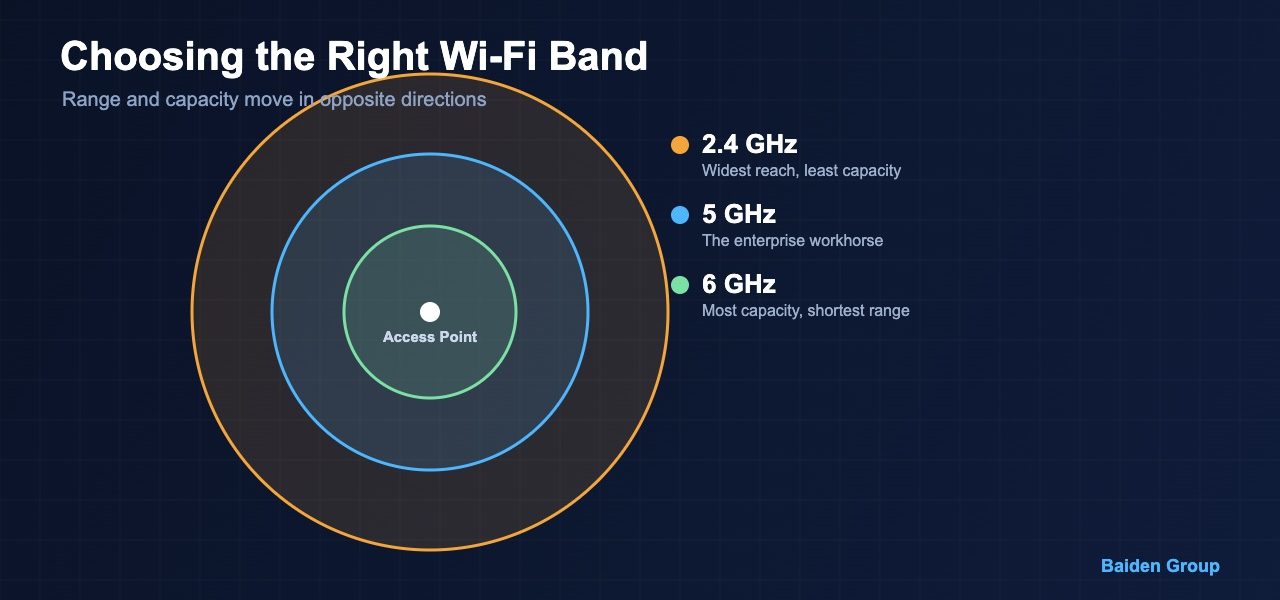
Every enterprise access point today broadcasts on more than one frequency band. However, most IT teams never decide which band should carry which traffic. Instead, they leave the defaults in place and hope the network sorts itself out. In practice, that hope costs you performance. Wi-Fi band selection is a real decision, and it shapes how your network behaves under load.
The three bands are not interchangeable
Wi-Fi runs on three bands now. Those bands are 2.4 GHz, 5 GHz, and 6 GHz. Each one trades range against capacity. Specifically, lower frequencies travel farther and punch through walls better. Higher frequencies carry more data but cover less ground. Therefore, the band you pick determines both how far a signal reaches and how much it can move.
The 2.4 GHz band reaches the farthest. However, it offers only three channels that do not overlap, and it is crowded with legacy devices, Bluetooth, and microwave leakage. As a result, it runs slow and noisy in almost every enterprise setting. Meanwhile, 5 GHz gives you many more channels and much higher throughput. For that reason, it has been the backbone of business Wi-Fi for years.
When each band earns its place
Use 2.4 GHz for reach and for older gear that supports nothing else. For example, some barcode scanners, sensors, and building controls still live only on 2.4 GHz. That said, keep real client traffic off it wherever you can. Instead, let 5 GHz carry the bulk of your modern devices. It offers plenty of channels, strong speed, and reasonable range. In most offices, warehouses, and clinics, 5 GHz is the workhorse.
The 6 GHz band is the newest option, and it changes the math. Notably, it adds a large block of clean spectrum with no legacy traffic on it. Consequently, it delivers wide channels and very low interference. However, its range is shorter than 5 GHz, and only recent client devices can even see it. In short, 6 GHz rewards new hardware and dense, high demand areas.
Why turning up power is not band selection
Many teams try to fix band problems by raising transmit power. Unfortunately, that approach usually makes things worse. Higher power on 2.4 GHz stretches a slow, crowded cell even farther across the floor. As a result, more clients cling to a band that cannot serve them well. Consequently, you get full bars and terrible performance at the same time.
Band steering is the better tool. In short, it nudges capable clients onto 5 GHz or 6 GHz and reserves 2.4 GHz for the devices that truly need it. That said, band steering only works when your channel plan and power levels are set correctly first. Otherwise, clients bounce between bands and roaming suffers. For this reason, band selection and cell sizing have to be designed together, not tuned in isolation.
Match the plan to your device fleet
Your band plan has to match what your clients can actually reach. For instance, a 6 GHz access point delivers nothing to a laptop that cannot tune to 6 GHz. In fact, most fleets still hold a mix of old and new devices. Therefore, audit the fleet before you design the channel and band plan. Generally, anything past roughly ten years old deserves a hard look, because older clients often cannot see 6 GHz or the higher 5 GHz channels. Ultimately, you build the plan around what the devices support, not around the access point spec sheet.
The practical takeaway for Canadian IT teams
Wi-Fi band selection is not a setting you flip once and forget. Instead, it follows from a real survey, a current device audit, and a channel plan built for your specific site. At Baiden Group, we design wireless networks, run RF site surveys, and troubleshoot the band and roaming problems that defaults tend to create. Ultimately, the goal is a network where every device lands on the band that serves it best.
Have questions about how these developments affect your network? Reach out to the Baiden Group team.