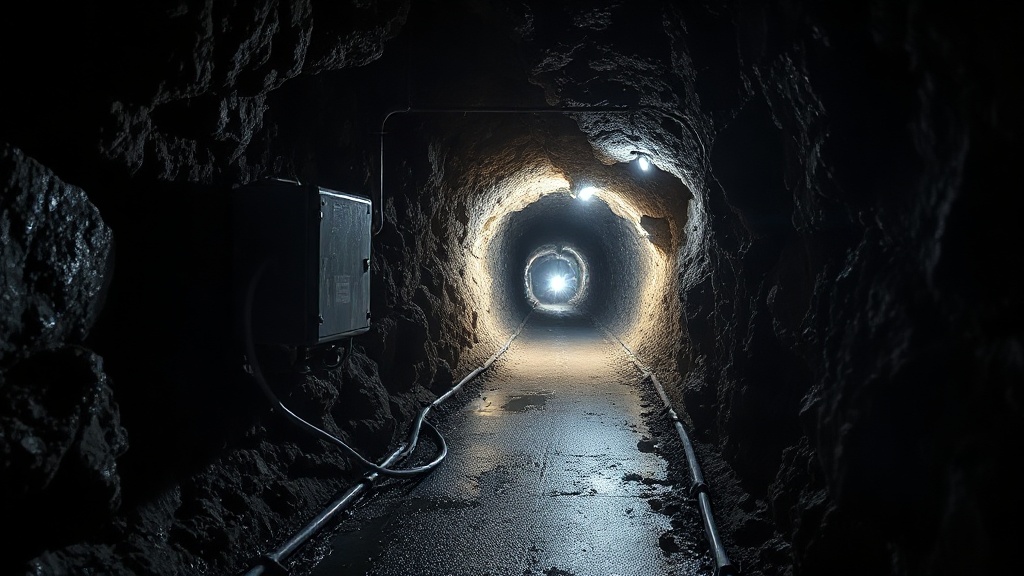
Wi-Fi in mining operations is one of the hardest jobs in enterprise networking. The environment is loud, dusty, and constantly moving. Moreover, the network is not a convenience in a mine. It is a safety system. In fact, when wireless fails underground, people lose contact with the surface and production stops. Here is what Canadian IT teams should plan for before they design it.
Surface and underground are two different problems
People often assume a mine is one environment. In practice, it is two. On the surface, you have open pits that stretch for kilometres. Signal has room to travel, but the distances are huge and the equipment moves fast. Autonomous haul trucks and telemetry need coverage across the whole pit. Therefore, surface designs lean on point-to-point backhaul, mesh links, and tall masts rather than office-style ceiling mounts. Temperature is the other surface problem. Gear that bakes at noon and freezes at night needs a wide operating range and often active heating.
Underground is the opposite. A tunnel acts like a waveguide, so signal follows the drift and then dies at the first corner. Rock absorbs RF, and intersections scatter it. Consequently, you cannot cover a heading from one radio down the hall. Instead, you place APs along the drift and add one at every junction. As the mine advances, the coverage has to advance with it. Also, fast-moving loaders need tight AP overlap for clean roaming, or sessions drop at speed.
The environment fights the hardware
Dust, vibration, water, and heat destroy consumer-grade gear. For this reason, mining APs live in sealed enclosures with high IP ratings. In gassy or coal operations, they also need intrinsically safe or explosion-rated housings. That is not optional. It is law. Cheap access points fail within a season here. Specifically, I have replaced radios that filled with rock dust until the fans seized.
Power and cabling are the next constraint. Copper Ethernet dies at 100 metres, and a drift runs far longer than that. Therefore, most mines run a fibre backbone and drop local power to each AP. Additionally, variable frequency drives on heavy machinery throw electrical noise across 2.4 GHz. In practice, I steer critical devices to 5 GHz and keep 2.4 GHz for legacy scanners only.
Wi-Fi coverage in mining operations is a moving target
You cannot predictive survey a tunnel the way you survey an office. The geometry changes every time crews blast and advance. Furthermore, rock density varies, so two drifts that look identical on a plan behave differently on air. I survey on site with the Ekahau Sidekick, then resurvey as the mine grows. Notably, skipping that step is how dead zones appear in a brand new heading. For that reason, I treat a mine survey as an ongoing service, not a one-time visit.
Safety and operations ride on the network
Here is why all of this matters. Modern mines run ventilation on demand, which sends fresh air only where people and equipment are working. Importantly, that system cuts huge energy costs, but it depends on reliable location tracking. Similarly, collision avoidance, personnel tags, and emergency radios all ride on the wireless layer. If the network drops, safety drops with it. In addition, autonomous haulage and remote loaders lean on the same wireless backbone. As a result, redundancy is not a luxury underground. I design ring topologies with redundant paths, so one cut fibre does not black out a level.
Mining rewards specialists who respect the environment. Conversely, it punishes those who treat it like an office. Ultimately, you design coverage, ruggedization, power, and redundancy as one system. At Baiden Group, we design wireless networks, run RF site surveys, troubleshoot live sites, and manage Wi-Fi for demanding environments across Canada. Have questions about how these developments affect your network? Reach out to the Baiden Group team.