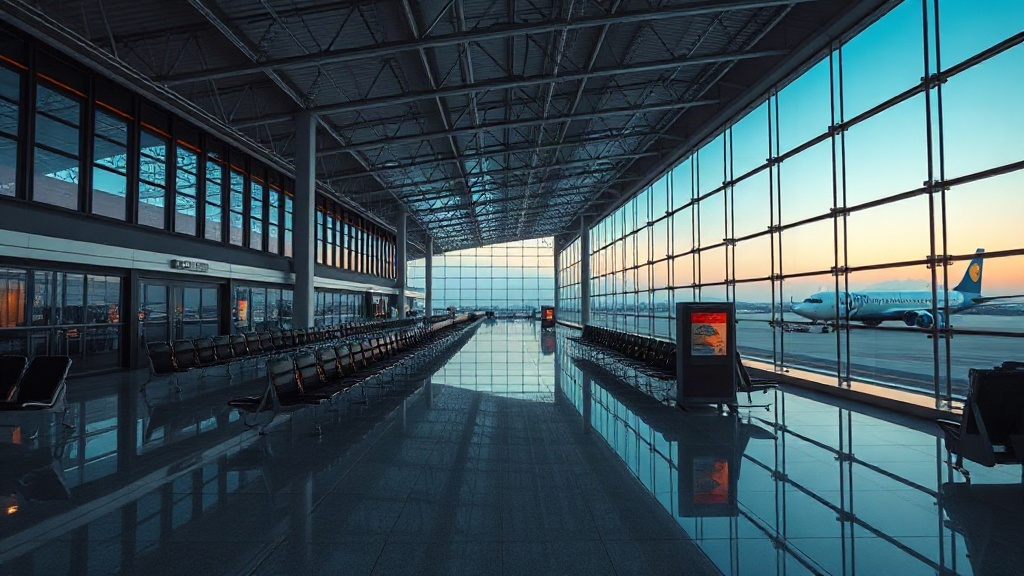
Airports look like open spaces, so many teams assume the Wi-Fi will be simple. However, a terminal is one of the hardest environments I design for. Crowds surge without warning. Dozens of tenants share the same air. Good airport Wi-Fi design has to account for all of it from day one.
Density Changes by the Hour
A gate area can hold twenty people at 2 a.m. and four hundred at 7 a.m. Therefore, capacity planning matters more than coverage. In fact, a signal that reaches every seat is useless if the radios cannot serve everyone. Passengers carry two or three devices each. Moreover, those devices scan constantly for networks. Consequently, airtime runs out long before signal does.
For this reason, I size every gate area for its peak load, not its average. Specifically, I use lower transmit power and smaller cells. Smaller cells let the same channel repeat across the concourse without interference. Also, high ceilings change antenna choices. Directional antennas often outperform omnidirectional units mounted twenty metres up.
Many Tenants Share One Building
An airport authority rarely owns every network in the terminal. Airlines run check in kiosks. Retailers run payment terminals. Ground handlers use rugged scanners on the ramp. Meanwhile, security and baggage systems run their own wireless networks. As a result, the spectrum fills with networks that do not coordinate. Each tenant picks channels independently, so overlapping channel interference builds quickly.
An RF site survey before design is essential here. It shows who already uses which channels. In practice, I find rogue access points in almost every terminal. Some are tenant hotspots. Others are forgotten test units. Importantly, the 6 GHz band gives relief where client devices support it. That said, many handheld scanners still rely on 2.4 GHz and 5 GHz. Plan for all three bands.
Roaming Matters for Operations
Passengers tolerate a dropped video call. Baggage handlers cannot tolerate a dropped scan. Similarly, gate agents need stable connections to boarding systems. Operational devices must roam cleanly across hundreds of access points. For example, fast roaming with 802.11r cuts handoff delay. However, it only works when every device on the SSID supports it. Test with the actual devices before go live.
Additionally, keep operational traffic apart from public guest traffic. Use separate SSIDs and VLANs. Then apply clear quality of service rules so a guest streaming video never slows a boarding scan.
Furthermore, validate the design after installation. A predictive model cannot capture every glass wall, kiosk, and baggage cart. Therefore, I walk the finished terminal with a survey tool and measure real throughput at each gate. Gaps found at this stage cost far less to fix than complaints found during a holiday rush.
Canadian Conditions Add Their Own Problems
Winter changes the building. Heavy coats absorb signal. Cold apron areas stress outdoor equipment. Therefore, access points near jet bridges and ramp doors need proper enclosures and temperature ratings. Furthermore, secure zones limit where equipment can go and when crews can install it. Privacy obligations under PIPEDA also shape how guest login data is handled. Raise these questions early, because they change the design.
Moreover, wired infrastructure sets the ceiling for everything above it. Access points in a long concourse need switch capacity, power budget, and cabling paths that match the radio plan. In contrast, a design that ignores the uplinks leaves expensive radios starved for bandwidth.
Plan for the Peak, Then Monitor
Airport networks reward careful planning. Start with a thorough RF site survey and a capacity model. Then design for the busiest hour, not the average one. Finally, monitor after launch, because terminals change constantly. New tenants arrive and walls move.
Baiden Group delivers Wi-Fi design, RF site surveys, troubleshooting, and managed Wi-Fi for large public facilities across Canada. Our team can help you build a network that holds up on the busiest day of the year.
Have questions about how these developments affect your network? Reach out to the Baiden Group team.