You paid for an RF site survey. A report landed in your inbox a week later. Now you have to decide whether to build a network around it. However, most IT teams accept the deliverable at face value because they have no easy way to judge it. In fact, a survey report can look polished and still be close to worthless. Some of the weakest designs I have reviewed came wrapped in the prettiest PDFs. For this reason, you need a way to evaluate an RF survey report before you trust a single number in it.
Check how the data was actually collected
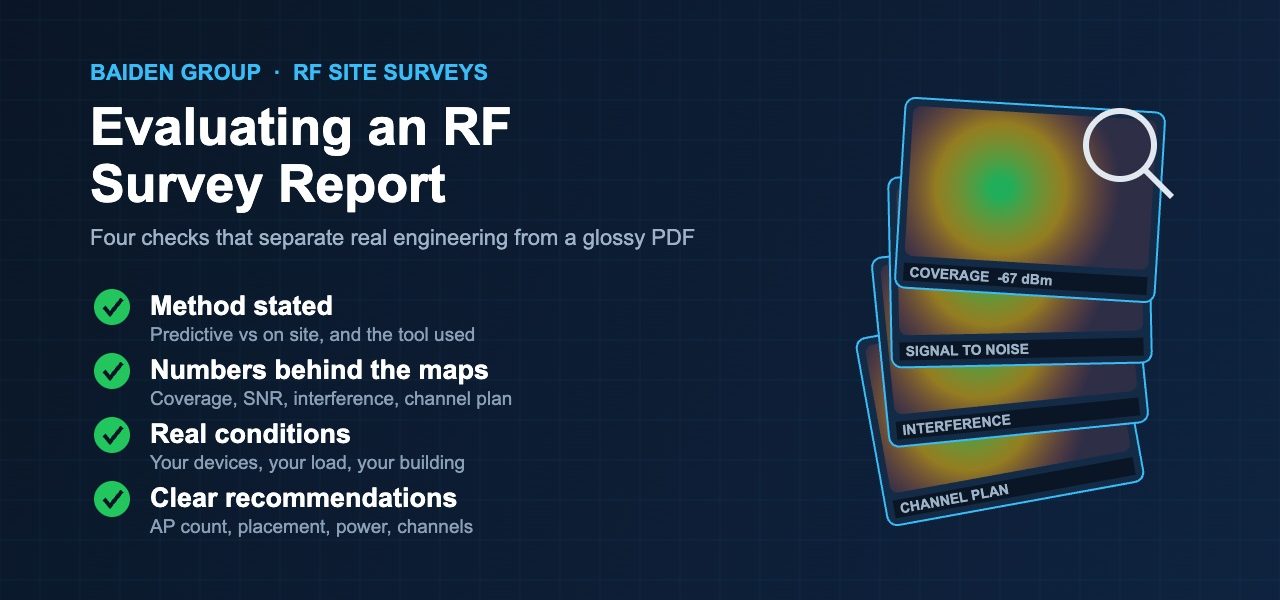
Start with the method, not the maps. Generally, a report should tell you exactly how the data was gathered. Was it a predictive design built in software from a floor plan? Was it an active survey walked on site with real gear? These are very different things. A predictive model is a starting point, and it assumes wall materials and attenuation values that may not match your building. Conversely, an on site survey measures what the RF actually does in your space. Notably, the best reports state the survey type on the first page and name the tool used, such as an Ekahau Sidekick. If you cannot tell how the numbers were produced, treat every result as a guess.
Look for the numbers, not just the heatmaps
Heatmaps sell reports. However, color is not proof. A green map means nothing until you know what threshold produced that green. Therefore, ask what signal level the design targets. For most enterprise networks, I want a stated minimum of around -67 dBm for primary coverage. I also want a signal to noise ratio target. Furthermore, a serious report shows more than one plot. It shows coverage, but it also shows signal to noise, data rate, channel overlap, and interference. In practice, a single pretty coverage map with no supporting plots is a red flag. Ask for the layers behind the picture.
Confirm the survey matches how you use the space
A survey is only useful when it reflects real conditions. For example, a warehouse surveyed empty behaves nothing like a warehouse packed with metal racking and stock. Similarly, an office surveyed at 6 AM misses the load of a full floor at 10 AM. Moreover, the survey has to account for your actual devices. A design tuned for laptops can still fail handheld scanners, medical carts, or older gear that cannot see 5 GHz DFS channels. Consequently, the report should name the client devices it designed for and note the environment it measured. If it ignores your real conditions, the coverage on paper will not survive contact with your floor.
Demand a clear set of recommendations
The point of a survey is a decision. Nevertheless, many reports stop at data and leave you to interpret it. A strong deliverable tells you what to do and why. Specifically, it should give AP counts, mounting locations, a channel plan, and transmit power settings. Additionally, it should flag problems it found, such as co channel interference or a source of non Wi-Fi noise. As a result, you finish the report knowing your next step. If the recommendations are vague or missing, you paid for pixels, not real data.
Trust the report that shows its work
Ultimately, a good report is transparent. It states the method, shows the numbers behind every claim, reflects how you actually use the building, and ends with clear direction. In short, it shows its work. That said, if a report hides its method or leans on one glossy heatmap, do not build on it. Instead, get a second opinion before you spend on hardware.
At Baiden Group, we run active RF site surveys and review designs done by others. We also troubleshoot networks that are underperforming and provide managed Wi-Fi. If you are holding a survey report and doubt it is sound, we can tell you what it is missing.
Have questions about how these developments affect your network? Reach out to the Baiden Group team.