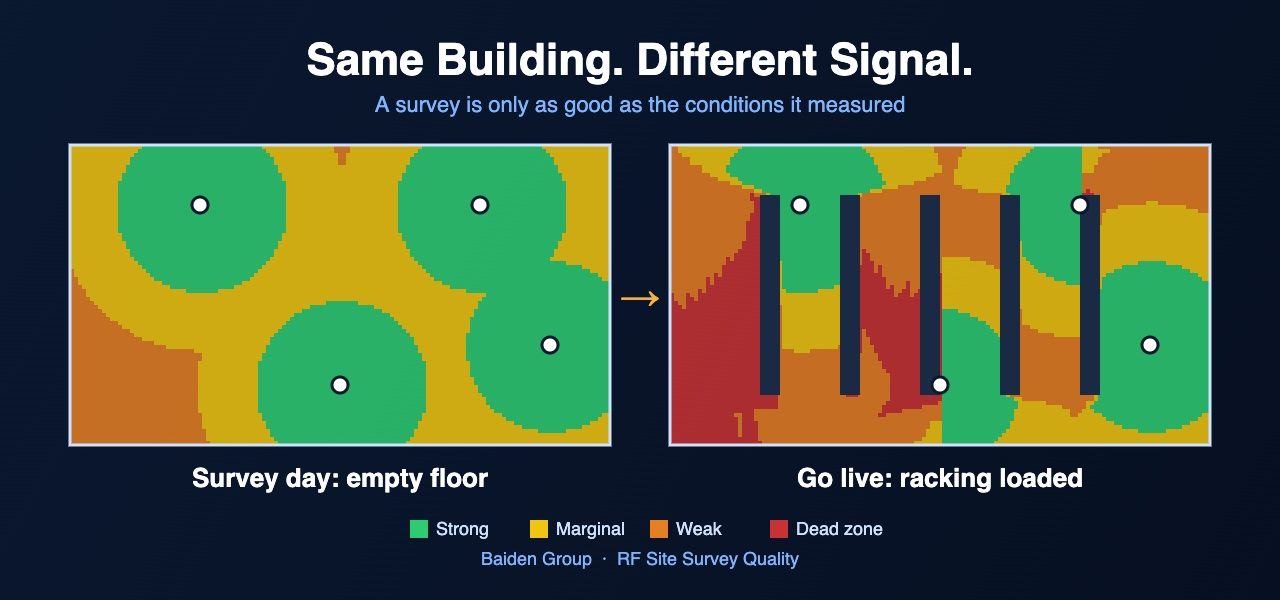
An RF site survey is the foundation of every good wireless network. However, not every survey deserves that trust. Over hundreds of jobs, I have seen reports that looked polished and still failed on day one. A survey is cheap compared to the cost of rebuilding a failed network. This article explains how to judge RF site survey quality before you sign off on a design.
What a Bad Survey Misses
Most weak surveys fail in the same few places. For example, the surveyor walks the building while it is empty and assumes it stays that way. Warehouses fill with pallets. Hospitals fill with staff, carts, and equipment. As a result, the signal map no longer matches reality once the building is in use.
Meanwhile, interference changes by the hour. A survey taken at 6 a.m. will not show the neighbouring tenant’s access points at noon. Neighbouring networks, microwave ovens, and handheld radios all add noise that an empty building hides. Similarly, many surveys test only one band. Today your clients use 2.4 GHz, 5 GHz, and often 6 GHz. Each band behaves differently through walls, glass, and racking. Therefore, a survey that measures one band cannot predict the others.
Additionally, a bad survey ignores the clients. A laptop sees the network very differently than a barcode scanner or a medical cart. Specifically, the weakest device on your network sets the real coverage target. In practice, surveyors who skip this step design for the best client, not the worst.
Signs of a Solid Survey
A good survey starts with questions, not measurements. Before anyone picks up a tool, the surveyor should ask about applications, device types, user density, and roaming needs. Moreover, they should ask about the building itself, including construction materials and planned changes.
Next, look at the method. Ideally, the surveyor uses a calibrated floor plan with correct wall attenuation values. They should also build a predictive model first, then validate it with real AP on a stick measurements. Indeed, this combination catches errors that either method alone would miss.
The report should show more than a pretty heatmap. For instance, you should see primary signal strength, signal to noise ratio, channel overlap, and secondary coverage for roaming. Notably, the report should state its design targets plainly, such as minus 67 dBm on the 5 GHz band. Without these numbers, a report is only a picture. Furthermore, you cannot hold anyone to targets that were never written down.
Questions to Ask Your Surveyor
You do not need to be an RF engineer to test a survey. Instead, ask a few direct questions. What coverage targets did you design to? Which client devices did you test with? How did you measure interference? In addition, ask whether the survey covered stairwells, loading docks, and outdoor areas that people actually walk through.
Also, ask when the survey should be repeated. Buildings change. Tenants move walls, racking shifts, and new interference sources appear. That said, a survey does not expire on a fixed date. Rather, you should revisit it after major renovations, a change in device types, or a move to a new Wi-Fi generation.
Canadian IT teams face an added challenge. Winter shipments, seasonal staffing, and older heritage buildings all change how a space behaves. For this reason, local experience matters. Baiden Group delivers RF site surveys, Wi-Fi design, troubleshooting, and managed Wi-Fi for hospitals, warehouses, and government sites. Every site we survey gets measured on every band your clients use, with the devices your staff carry. In short, we measure what matters, and we show our work.
Have questions about how these developments affect your network? Reach out to the Baiden Group team.