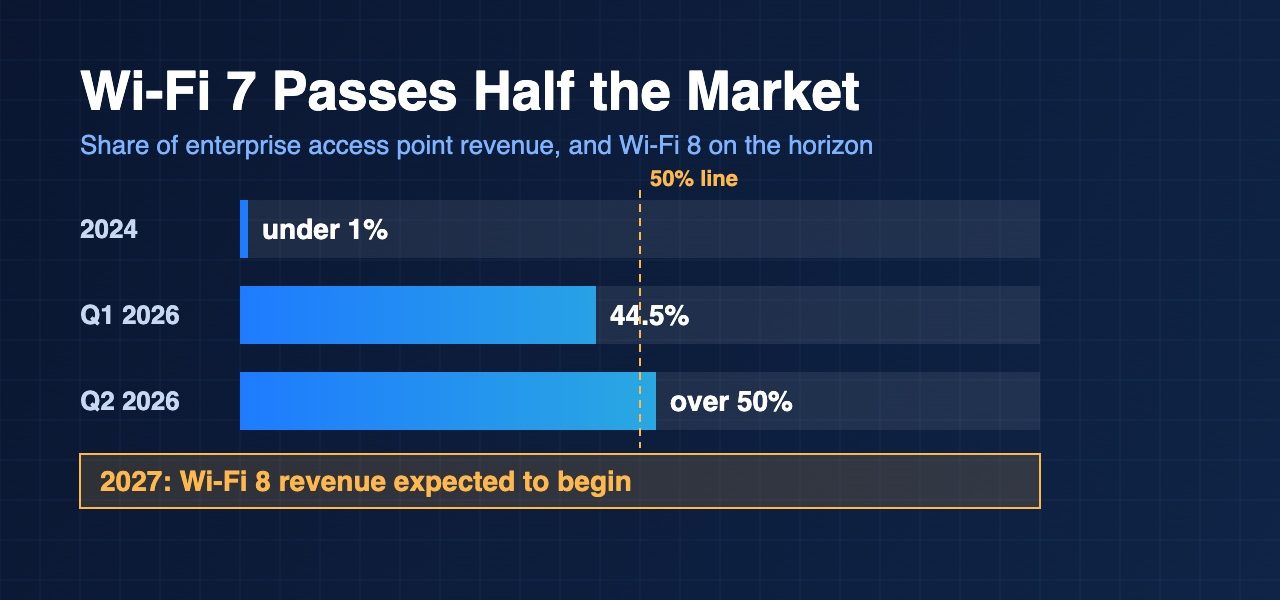
Wi-Fi 7 now holds more than half of the access point market. In fact, vendors shipped over 10 million access points in the second quarter of 2026, an industry record. Meanwhile, Wi-Fi 8 is moving closer than most IT teams expected. Therefore, every Wi-Fi 7 upgrade plan deserves a fresh look this fall.
What the Market Numbers Say
Dell’Oro Group reports that Wi-Fi 7 passed 50 percent of the market in the second quarter of 2026. IDC tells a similar story for the first quarter. According to IDC, Wi-Fi 7 captured 44.5 percent of enterprise access point revenue. Two years earlier, that share was under one percent.
Wi-Fi 6 fell to 34.8 percent over the same period. Wi-Fi 6E held steady at 20 percent. Additionally, the Americas led regional growth at 17 percent year over year. Cisco, HPE, and Ubiquiti remain the top three vendors by share.
These figures matter because they show where vendors invest their engineering effort. Consequently, Wi-Fi 6 products will see fewer feature updates over time. Specifically, buyers are asking for Multi-Link Operation, 320 MHz channels, and 4096-QAM. Those features suit dense, latency sensitive environments.
Why Wi-Fi 8 Is Arriving Early
Dell’Oro now expects Wi-Fi 8 revenue to appear in 2027. Memory costs are the reason. Rising DDR4 prices, tied to AI infrastructure demand, are squeezing vendor margins. As a result, chipmakers are designing Wi-Fi 8 parts that need fewer expensive memory chips.
The IEEE 802.11bn standard is not yet final. However, vendors are showing early silicon anyway. In practice, first generation Wi-Fi 8 gear may need firmware updates to match the final standard. Buyers should plan for that risk.
Notably, Wi-Fi 8 focuses on reliability rather than raw speed. It targets better performance at the cell edge, in congested spaces, and during roaming. Those are the problems I diagnose most often on site.
Nevertheless, Wi-Fi 7 will stay relevant for years. Dell’Oro expects Wi-Fi 7 revenue to keep growing through 2028. Furthermore, it forecasts that enterprise Wi-Fi 7 will earn more lifetime revenue than Wi-Fi 6E. A Wi-Fi 7 purchase today is therefore not a mistake. It simply needs a clear refresh plan behind it.
What This Means for Canadian IT Teams
Canada opened the full 6 GHz band to Wi-Fi in 2021. Therefore, Canadian organizations can use Wi-Fi 7 across all three bands today. That is a real advantage over some other regions.
Supply is the bigger concern. Memory shortages are creating variable lead times. Moreover, Dell’Oro expects average selling prices to keep rising through 2026. Organizations that delay may pay more and wait longer. At the same time, buying too early carries its own risk.
For this reason, I suggest a simple approach. First, buy Wi-Fi 7 where you have real demand today, such as dense offices, warehouses, and hospitals. Second, keep Wi-Fi 6 in low density areas. Third, ask vendors for written firmware support commitments. Finally, confirm that your switches can deliver multi gigabit uplinks.
Also, do not skip the RF site survey. A new access point cannot fix a poor design. In my experience, bad placement causes more problems than old hardware. Indeed, a Wi-Fi 7 access point in the wrong spot still delivers weak coverage. Ultimately, the survey decides whether the new hardware performs as promised.
How Baiden Group Can Help
Baiden Group helps Canadian organizations make these decisions with confidence. We provide Wi-Fi design, RF site surveys, troubleshooting, and managed Wi-Fi. For example, we can map which areas of your facility justify Wi-Fi 7 now. In addition, we can validate vendor claims before you commit budget. That way, your upgrade fits your real traffic and your real building.
Have questions about how these developments affect your network? Reach out to the Baiden Group team.