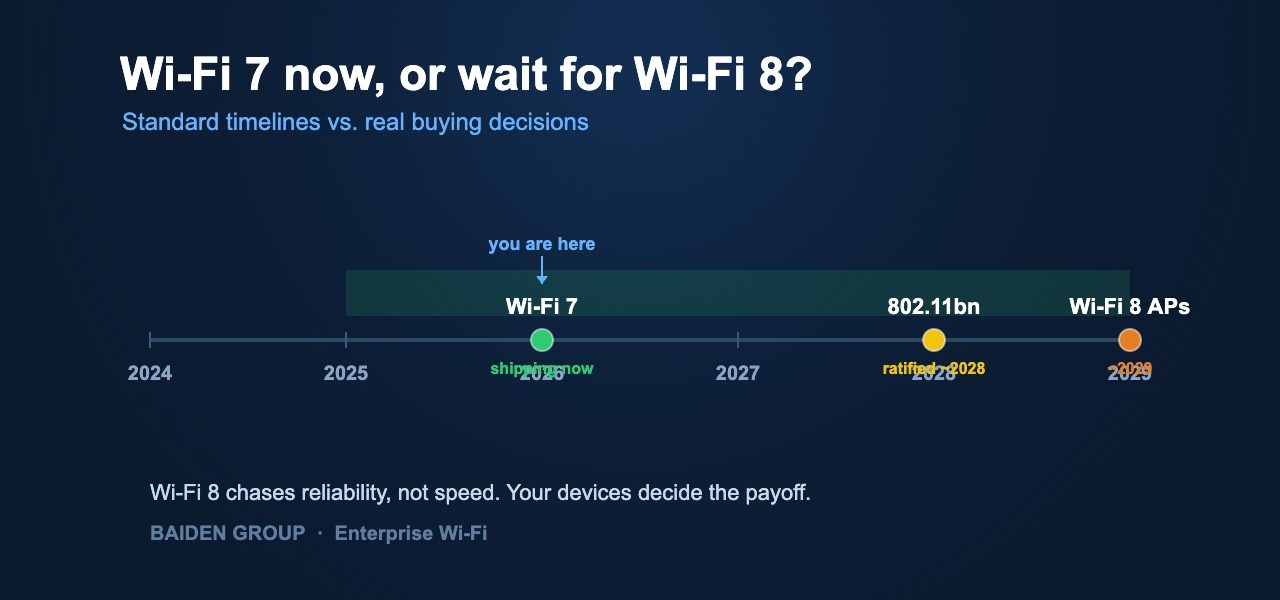
Every few years a new Wi-Fi standard arrives, and the same question lands in my inbox. Should we wait for the next one before we spend money? Right now that question is about Wi-Fi 8, the standard the industry calls 802.11bn. In fact, I hear it on nearly every survey call. So let me give you a straight answer based on where the standard actually sits today.
Where Wi-Fi 8 stands today
Wi-Fi 8 is still a draft. The IEEE targets formal ratification for around September 2028. Consequently, real enterprise hardware will not ship in volume until well after that date. Most analysts expect managed business grade access points roughly 12 to 18 months after ratification. Therefore you are looking at 2029 before you can buy Wi-Fi 8 gear worth deploying in production.
Meanwhile, Wi-Fi 7 is already here and shipping in large numbers. Access point shipments jumped from about 26 million units in 2024 to a projected 66 million in 2025. Furthermore, forecasts put 2026 near 118 million units. In short, Wi-Fi 7 is now the default refresh for enterprise networks.
What Wi-Fi 8 actually delivers
Here is the part vendors gloss over. Wi-Fi 8 does not raise the top speed. It holds the same theoretical ceiling as Wi-Fi 7, near 46 Gbps. Instead, the entire focus is reliability. Specifically, the standard chases lower latency, fewer dropped packets during roaming, and steadier performance in crowded radio environments.
The published targets are modest and honest. For example, the working group aims for about 25 percent lower latency at the 95th percentile and 25 percent less packet loss during roaming. New features such as multi access point coordination and non primary channel access drive those gains. Notably, these help most in very dense spaces where many radios fight for airtime.
What this means for your refresh
For most Canadian organizations refreshing in 2026 or 2027, the answer is Wi-Fi 7 now. Waiting for Wi-Fi 8 means deferring a needed upgrade by three years or more. Moreover, your client devices tell the real story. Even when Wi-Fi 8 access points arrive, your laptops, phones, and scanners will not carry Wi-Fi 8 radios for years after.
We saw this exact pattern with 6 GHz. Many Windows laptops still shipped without a 6 GHz radio well into 2026. As a result, buyers who chased the access point spec sheet never got the benefit, because the client fleet could not reach the new channels. In practice, a network is only as fast as the slowest device that matters to your business.
How to decide
Start with your actual problem, not the marketing calendar. Are users dropping sessions, roaming badly, or crowding a few access points at peak times? If so, a proper design and survey on Wi-Fi 7 will fix that today. Conversely, if your current network is stable and three years from end of life, there is no rush to rip and replace.
Ultimately, standards are a tool, not a deadline. The right time to upgrade is when your business need and your device fleet line up, not when a press release drops. That said, a good design outlasts any single standard, so build for what your devices can actually use.
At Baiden Group we help Canadian enterprises cut through the standards noise with real RF site surveys, honest network design, and troubleshooting that finds the actual problem. Whether you deploy Wi-Fi 7 today or plan for Wi-Fi 8 later, we design around your devices and your building. Have questions about how these developments affect your network? Reach out to the Baiden Group team.