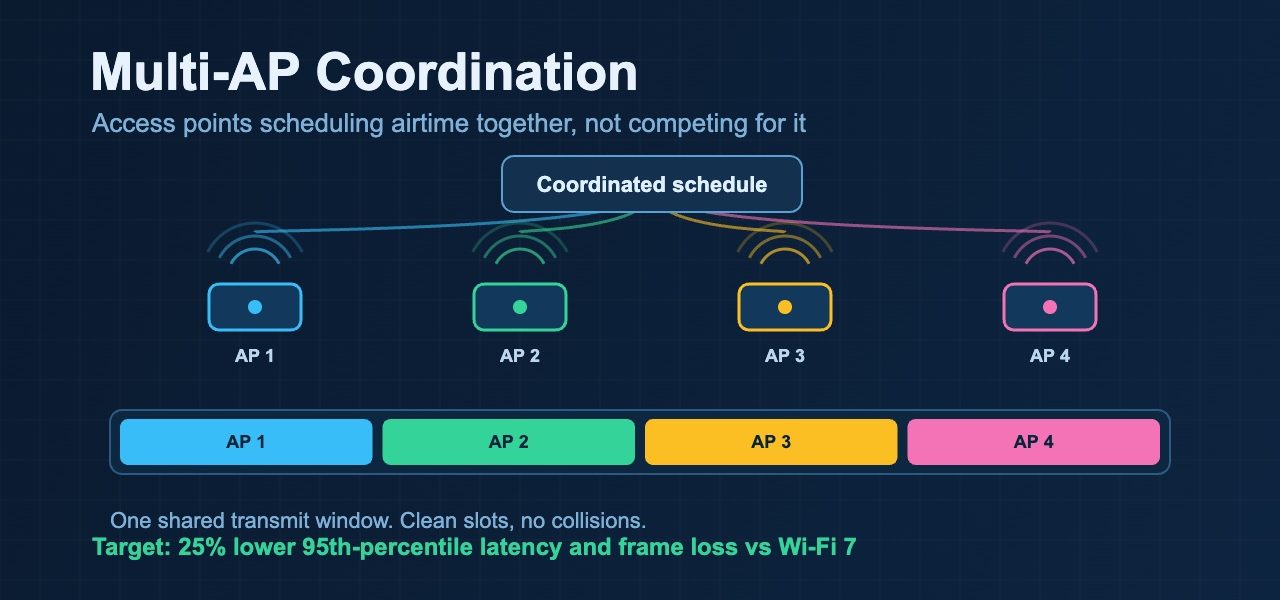
Wi-Fi 8 is not a speed upgrade. The top data rate barely moves over Wi-Fi 7. Instead, the IEEE 802.11bn group chose a different target. They call it Ultra High Reliability. In practice, they want your network to behave the same when a room is packed as it does when it sits empty. Notably, most of that promise rests on one feature. That feature is Wi-Fi 8 Multi-AP Coordination.
The problem Wi-Fi 8 is trying to solve
Today every access point makes its own decisions. It listens to the channel, waits for a gap, then transmits. However, that model breaks down when access points sit close together. In dense sites they hear each other and back off constantly. As a result, airtime gets wasted and latency spikes at the worst moments. Meanwhile, one slow or distant client can drag down a whole cell. For a hospital or a busy warehouse, that unpredictability is the real problem. Coverage looks fine on paper. Consequently, the network still stalls when the floor fills up.
What Multi-AP Coordination actually does
Multi-AP Coordination lets neighbouring access points work as a team instead of competitors. Specifically, the 802.11bn draft defines several coordination modes. Coordinated scheduling shares a single transmit window between access points. In addition, coordinated spatial reuse lets two access points transmit at once at controlled power. Coordinated beamforming steers signals so they do not collide. The draft also coordinates restricted target wake time, which protects time sensitive traffic across a whole area. Importantly, the reliability targets are concrete. The draft aims to cut 95th percentile latency and frame loss by at least 25 percent versus Wi-Fi 7. That last number matters more than any speed figure. For example, a warehouse running voice and scanners cares about consistent latency, not a higher peak rate. Similarly, a hospital pushing clinical data needs frames to arrive on time, every time.
The quieter fix nobody talks about
Multi-AP Coordination gets the attention. Another feature deserves just as much. It is called non primary channel access, or NPCA. Today a radio only transmits on its primary channel. When that channel is busy, the radio waits, even when a wide block of spectrum sits idle beside it. NPCA changes that behaviour. Instead, the radio can shift its operation to a free secondary channel and keep working. For latency sensitive traffic, that is a large gain. In fact, early analysis shows NPCA paired with smarter queuing cuts 95th percentile latency by more than 25 percent. Therefore, the benefit shows up as fewer stalls, not bigger speed test numbers. Researchers are already testing these features in open simulators built for 802.11bn. Overall, the early results back up the reliability claims rather than the marketing headlines.
What this means for Canadian IT teams
None of this ships in a ratified standard yet. The IEEE targets final approval of 802.11bn around 2028. Meanwhile, vendors will market early Wi-Fi 8 gear well before that date. That gap creates a familiar trap. Coordination features only work when your access points come from the same vendor and run compatible firmware. Therefore, a mixed fleet will not deliver the reliability the brochure promises. For most Canadian teams, the smart move is patience paired with planning. First, audit your current pain points. Then ask whether they are coverage problems or capacity problems. In many cases a proper survey and a tuned Wi-Fi 7 design solves the issue today, without waiting for 2028.
Wi-Fi 8 Multi-AP Coordination is a genuine step forward for dense, demanding sites. Still, it rewards networks that are already designed well. Baiden Group helps Canadian teams with Wi-Fi design, RF site surveys, troubleshooting, and managed Wi-Fi, so your network is ready for what comes next. Have questions about how these developments affect your network? Reach out to the Baiden Group team.