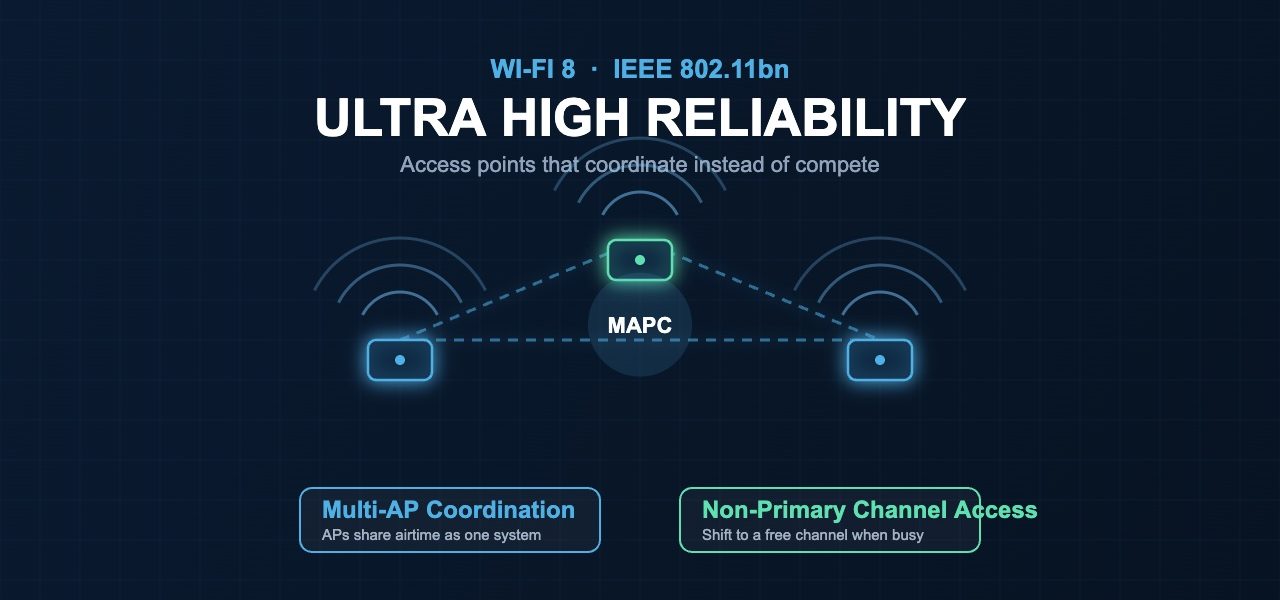
Wi-Fi 8 is not a speed story. The IEEE 802.11bn standard, branded Wi-Fi 8 by the Wi-Fi Alliance, targets reliability instead. Specifically, the working group set a goal called Ultra High Reliability. However, most coverage still frames every new standard around bigger throughput numbers. In practice, the real work sits in two mechanisms most buyers have never heard of. Therefore this post explains the Wi-Fi 8 reliability features that actually matter: multi-AP coordination and non-primary channel access.
Reliability, Not Just Speed
First, the timeline. Draft 1.0 landed in July 2025, and the standard is projected to finalize around May 2028. Meanwhile, Wi-Fi Alliance certification is planned for early 2028. So nobody is deploying Wi-Fi 8 gear this year. Nevertheless, the design goals are worth understanding now, because they shape your next refresh cycle.
Notably, 802.11bn aims to cut the 95th percentile of latency, reduce packet loss, and raise throughput in hard conditions. Each target sits at roughly 25 percent better than Wi-Fi 7. In other words, the standard chases the worst moments on your network, not the best. That focus matters far more than a headline data rate on a spec sheet.
Multi-AP Coordination Ends the Every-AP-for-Itself Model
Today, each access point makes its own decisions. Consequently, neighbouring APs on the same channel talk over each other and waste airtime. Multi-Access Point Coordination, or MAPC, changes that model. Specifically, nearby APs coordinate who transmits and when.
Furthermore, 802.11bn defines several coordination schemes. For example, coordinated spatial reuse lets two APs transmit at once with managed power. Similarly, coordinated beamforming uses nulling so one radio does not drown out another. In addition, coordinated scheduling packs more transmissions into a shared window. Together, these methods treat a cluster of APs as one system rather than as rivals.
For dense sites, this is the headline. Think hospitals, warehouses, and convention floors. In those spaces, coverage is rarely the real problem. Instead, APs fighting each other for airtime is the problem. Therefore coordination targets exactly the failure mode I see most often on packed floors.
Non-Primary Channel Access Reclaims Wasted Airtime
The second mechanism is Non-Primary Channel Access, or NPCA. Normally, a radio waits when its primary channel is busy with a neighbour’s traffic. As a result, usable spectrum sits idle while devices stall. NPCA lets the device shift to a secondary channel and transmit there instead.
In effect, the network stops parking clients behind a busy channel. Consequently, access delay drops and capacity improves inside crowded buildings. Moreover, vendors are already testing a coordinated version where APs agree on those backup channels. Overall, NPCA attacks the same enemy as MAPC, which is wasted airtime in dense overlap.
What This Means for Canadian IT Teams
To be clear, none of this rescues a bad design. These features assume your APs sit in the right places and your channels are planned. Otherwise, coordination has nothing solid to coordinate. For that reason, the fundamentals still decide whether Wi-Fi 8 delivers anything at all.
Practically, do not rip out working gear to chase a 2028 standard. Instead, plan your next refresh around client devices and real site conditions. Additionally, ask any vendor how their coordination features behave with mixed older clients on the floor. Many devices in your fleet will never support these tricks. Ultimately, the standard rewards networks that were surveyed and designed properly in the first place.
At Baiden Group, we design wireless networks, run RF site surveys, troubleshoot live problems, and manage Wi-Fi for enterprise clients across Canada. New standards arrive on schedule, yet the field work stays the same. We measure what is actually in your building and build around it. Have questions about how these developments affect your network? Reach out to the Baiden Group team.