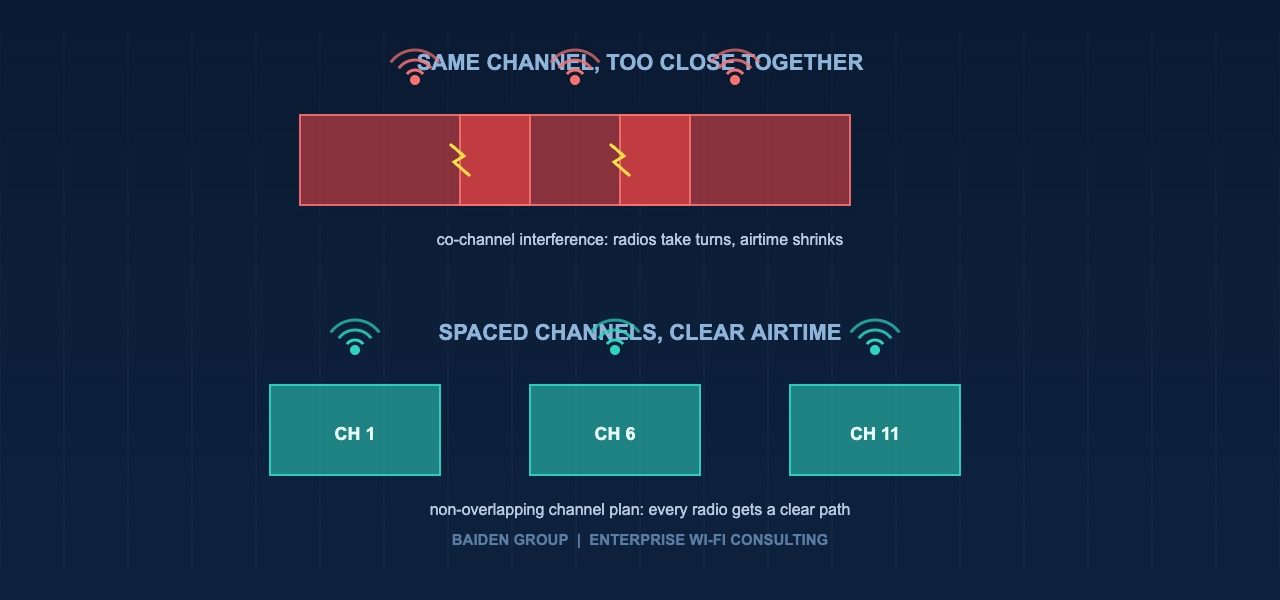
Every network we walk into starts with the same question. How is the wireless spectrum actually being used? In practice, most Canadian enterprise networks get Wi-Fi channel planning wrong. Poor channel planning shows up as dropped calls, slow roaming, and patchy coverage. Understanding why it happens helps IT teams make better decisions before the next refresh. This matters just as much for a hospital wing as it does for a warehouse floor.
What Channel Planning Actually Solves
Wi-Fi operates on a shared, unlicensed medium. Multiple access points and client devices all compete for the same airtime. Channel planning assigns each access point a frequency so its coverage does not clash with its neighbors. Consequently, a well planned network gives every device a clear path to talk and listen. A poorly planned network forces devices to wait, retransmit lost frames, and fall back to slower data rates. For example, a laptop near the elevator may lose its connection even though the access point sits nearby. Meanwhile, a video call in the boardroom next door starts to stutter for no obvious reason. These symptoms often get blamed on the internet connection when the real cause sits inside the building.
Co-Channel Interference vs Adjacent-Channel Interference
Two access points on the same channel create co-channel interference. They can hear each other, so they take turns politely. That turn taking still eats into the airtime available to everyone nearby. Adjacent-channel interference is different, and often worse. It happens when nearby channels overlap just enough to create noise without any coordination. Notably, that noise looks like distance to a client radio, even when the access point is close by. For this reason, a solid channel plan treats spacing as a core design constraint. Specifically, careful channel assignment across the 2.4 GHz, 5 GHz, and 6 GHz bands keeps neighboring radios from stepping on each other. Indeed, this single design choice explains a large share of the performance complaints we investigate on site visits.
Why More Spectrum Does Not Mean You Can Skip Planning
The arrival of 6 GHz added a wide, clean stretch of new spectrum to enterprise Wi-Fi. Generally, IT teams assume more channels make interference disappear. In practice, that is not how it works. 6 GHz still obeys the same physics as 5 GHz. Wide channels, especially 160 MHz ones, use up more of that new spectrum per access point. Similarly, dense environments like hospitals and warehouses can still pack access points close enough to interfere. Moreover, most sites keep running dual band and tri band clients for years after a 6 GHz rollout. As a result, 2.4 GHz and 5 GHz channel planning still matters just as much as before. On top of that, outdoor 6 GHz power rules in Canada are still evolving, so a plan built around assumed power levels can age poorly.
What Good Channel Planning Looks Like in Practice
Good channel planning starts with an accurate RF site survey, not a floor plan guess. Real measurements of building materials, ceiling height, and interference sources show where access points actually belong. A sound channel plan also assigns non-overlapping channels wherever access points sit close together. Additionally, it sets transmit power to match actual coverage needs rather than maximum output. In testing, we regularly find networks running default settings and full power on every radio. That configuration all but guarantees interference. Overall, adjusting it is often the single highest impact change we make on a site visit. Furthermore, a good plan gets revisited whenever the building layout, device count, or client mix changes in a meaningful way. Otherwise, a network that performed well at launch can quietly degrade over a year or two.
Channel planning is not glamorous work, but it decides whether a network feels fast or frustrating. Baiden Group builds channel plans from real RF site surveys, not assumptions. In addition, we troubleshoot existing networks when planning has gone wrong. Whether you need a new design, a site survey, or ongoing managed Wi-Fi support, that work starts with understanding how your spectrum is used. Ultimately, a network that respects the fundamentals of RF gives your team fewer support tickets and fewer surprises.
Have questions about how these developments affect your network? Reach out to the Baiden Group team.