Most enterprise Wi-Fi complaints get blamed on weak coverage. In reality, the channel plan is often the real bottleneck. Specifically, Wi-Fi channel planning decides how your access points share the air. As a result, a network with full signal bars can still crawl during busy hours.
A channel is a lane, not just a frequency
Think of each Wi-Fi channel as a lane on a road. Devices sharing one lane must take turns. In other words, two radios on the same channel cannot talk at once without colliding.
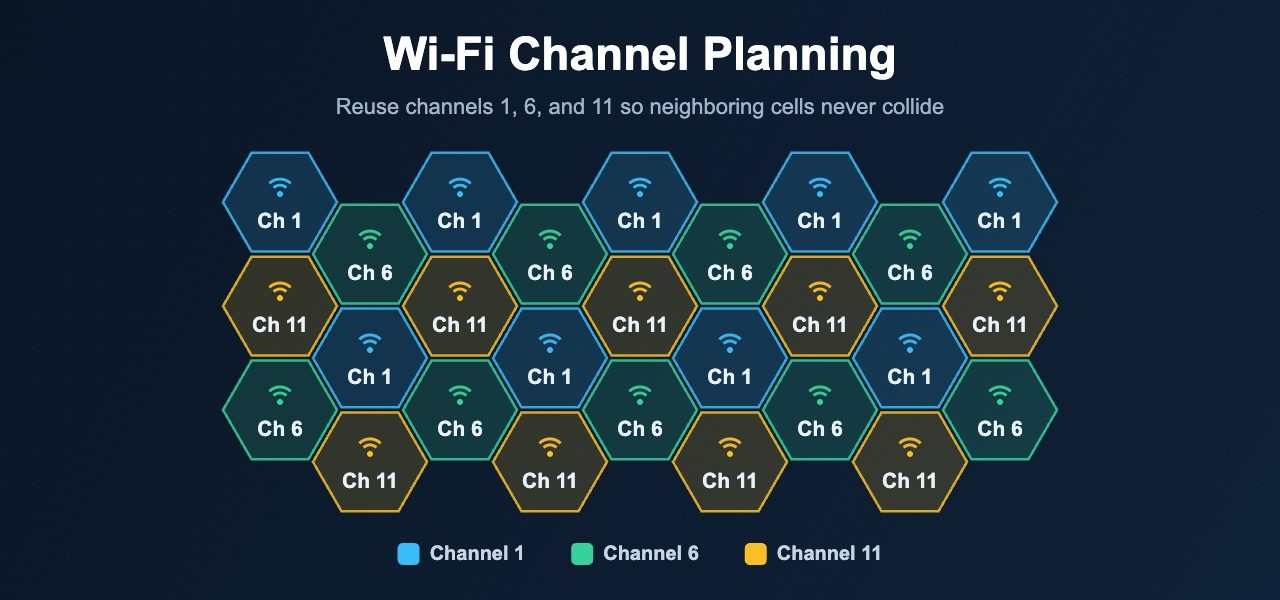
The 2.4 GHz band is the tightest space of all. Notably, it offers only three non-overlapping channels in North America, numbers 1, 6, and 11. Every other channel bleeds into its neighbors. By contrast, the 5 GHz band is far roomier. It provides many more clean channels, which is why serious networks lean on it. In addition, many 5 GHz channels are DFS channels, which share spectrum with radar. Furthermore, the 6 GHz band adds even more open spectrum for Wi-Fi 6E and Wi-Fi 7 gear.
Co-channel interference is the hidden tax
When two access points share a channel, they do not add capacity. Instead, they split it. As a result, both radios and their clients must wait for a clear moment before sending. Specialists call this co-channel interference. In practice, it is the quiet tax on a badly planned network.
Picture three access points in one open office, all left on channel 6. Thus, they form a single shared lane, not three. Consequently, a third of your hardware budget delivers no extra throughput. Moreover, every device competes with more neighbors for a smaller share of the network.
Here is where many teams go wrong. Faced with a slow area, they add more access points. However, if those radios land on channels already busy nearby, the extra hardware backfires. Specifically, more radios on one channel means more devices contending for the same airtime.
Good channel reuse is a pattern, not a guess
A good plan treats channels like colors on a map. Generally, no two neighboring cells should share the same one. Meanwhile, cells far enough apart can safely repeat a channel, since their signals no longer collide. Overall, this reuse pattern is the heart of Wi-Fi channel planning.
Channel width matters too. Wider channels carry more data, yet they eat more of the band and leave fewer clean options. In fact, in dense sites narrower channels often perform better, because they create more reuse room. For this reason, the right width depends on how many APs must coexist, not on the biggest number a datasheet shows.
What this means for your network
First, learn to recognize the symptom. Generally, a channel problem shows up as a network that is fine when empty and slow when full. Notably, coverage tests look perfect, because signal strength is not the issue. Indeed, the clue is timing, since contention only bites once many devices are active.
You cannot fix this by turning up transmit power. In fact, higher power makes each AP shout louder and widens the zone where it steps on its neighbors. Similarly, adding hardware without a plan just adds contention. Instead, the real fix is a deliberate channel and power design, validated on site.
Automatic channel selection helps, but it is not a full answer. Vendor systems adjust channels on their own, yet they often react slowly and make blunt choices. Therefore, treat these auto features as a starting point, then verify the result with a survey. That said, a real site walk still catches what an algorithm misses.
Channel planning is not glamorous, yet it decides whether your investment in access points pays off. At Baiden Group, we design channel and power plans, run RF site surveys to validate them, and troubleshoot the interference that slow networks hide. Ultimately, a sound plan keeps your Wi-Fi fast when the building fills up, whether you run one site or many.
Have questions about how these developments affect your network? Reach out to the Baiden Group team.