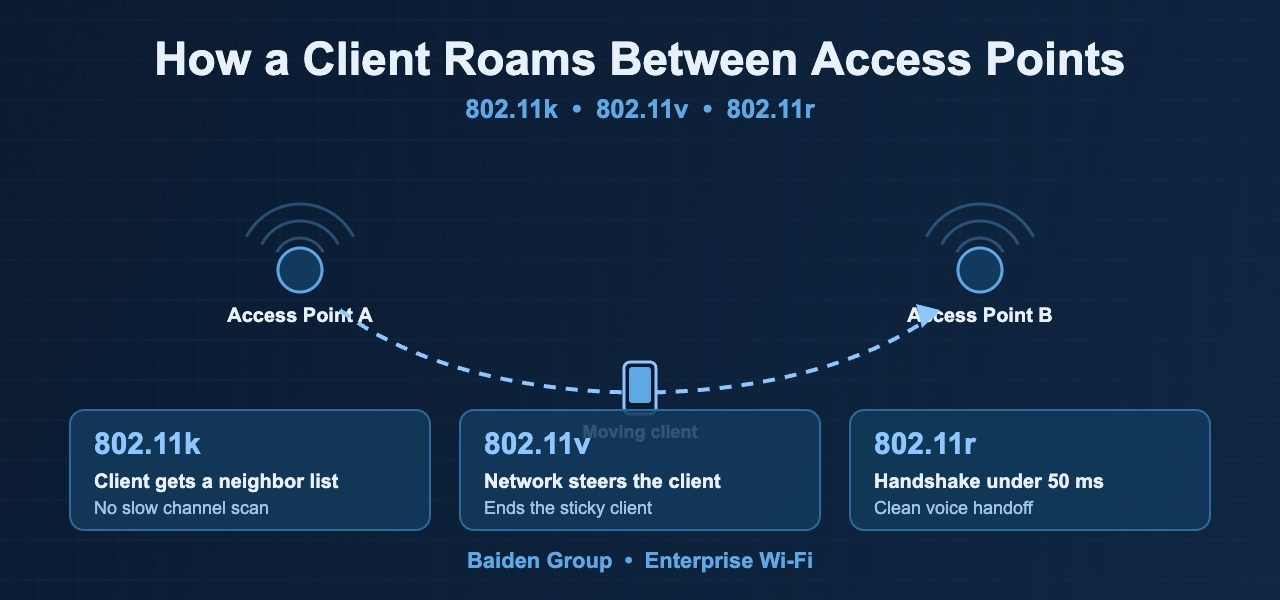
Most Wi-Fi complaints in a large building are not coverage problems. They are roaming problems. Devices cling to a distant access point long after a closer one becomes available. Voice calls drop, barcode scanners stall, and video freezes for a beat. However, three IEEE amendments were written to fix exactly this, and most enterprise networks already own them. In fact, the 802.11 roaming standards quietly decide whether your Wi-Fi holds together when people move.
Roaming is a client decision, not a network one
Roaming happens when a device leaves one access point and joins another. Importantly, the device decides when to make that jump, not the network. Therefore a badly behaved client can hold on to a weak signal while a strong access point sits idle a few metres away. In practice, this is the sticky client problem. Notably, it generates more help desk tickets than dead zones ever do. That said, the industry gave us tools to influence the decision, and the 802.11 roaming standards are those tools.
802.11k tells the client where to go
802.11k gives the client a neighbor report. Specifically, the access point hands the device a short list of nearby radios worth roaming to. As a result, the client skips a slow scan across every channel and band. Scanning takes time, and time is exactly what a moving voice call cannot spare. Consequently, roaming decisions land faster and with better targets. For a nurse walking a ward or a picker crossing a warehouse, that speed is the difference between a session that survives and one that resets.
802.11v lets the network steer the client
802.11v flips the control the other way. Instead of waiting for a stubborn device to act, the network suggests a better access point. For example, a controller can nudge a laptop off a crowded radio toward a quieter one nearby. Notably, this addresses the sticky client problem that 802.11k alone cannot solve. However, the client can still decline the suggestion, so vendor behavior matters a great deal. In testing, I have seen two devices from the same fleet respond to the same steering request in completely different ways.
802.11r makes the roam fast and secure
802.11r handles the security handshake during the move. Normally a full re-authentication adds two to three hundred milliseconds to every roam. Meanwhile 802.11r compresses that exchange to under fifty milliseconds. For voice and real time video, that gap is the difference between a clean handoff and a dropped call. Thus the three amendments work as a set. One tells the client where to go, one steers it, and one makes the move quick. Together they turn roaming from a gamble into a managed process.
What this means for procurement and rollout
These standards are not new, and that is the point. Most enterprise access points already support all three today. However, support on the access point means nothing if the feature is switched off or if your client fleet ignores it. For instance, older handheld scanners and some medical devices lack 802.11r, so enabling it network wide can break their connections outright. Therefore you test the client fleet before you flip anything on. Additionally, a real RF site survey confirms that neighbor lists and steering thresholds match the physical layout of the building. Generally, the failures I get called in to fix are not missing standards. They are standards enabled blindly, without checking what the devices on the floor can actually do.
Roaming is where Wi-Fi either feels invisible or falls apart. At Baiden Group, we design networks around how devices actually move, run RF site surveys that validate roaming behavior, and troubleshoot the sticky client problems these standards are meant to solve. Ultimately, the 802.11 roaming standards only help when someone configures them for your building and your devices. Have questions about how these developments affect your network? Reach out to the Baiden Group team.