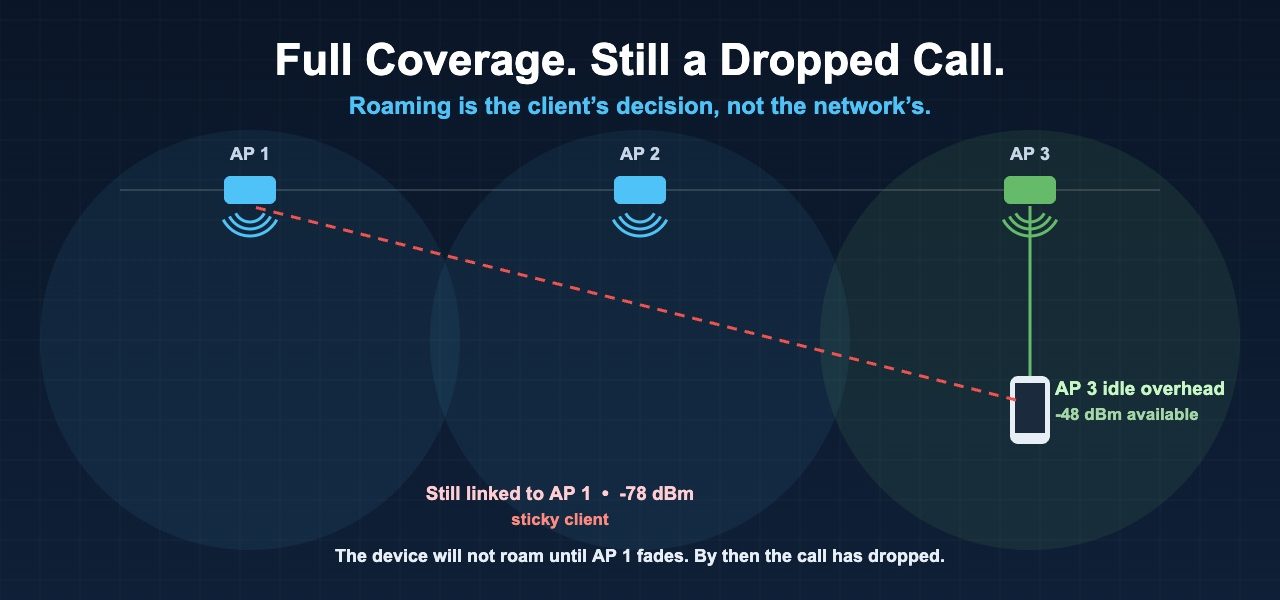
A user walks from one end of the building to the other on a call. The call drops halfway, even though access points line the ceiling the entire way. Coverage is not the problem here. The device simply refused to let go of the access point it started on. This is a roaming problem, and it is one of the most misunderstood parts of enterprise Wi-Fi.
What Wi-Fi roaming actually is
Roaming is the process of a client moving its connection from one access point to another as you move through a building. Ideally it happens fast and without a noticeable break. However, the decision to roam does not belong to the network. It belongs to the client. Your phone, laptop, or barcode scanner decides when to switch, based on its own firmware and thresholds. As a result, two devices standing side by side can behave completely differently.
Why devices cling to the wrong access point
Most devices are lazy about roaming. Specifically, they hold onto their current access point until the signal gets quite weak, often around -75 dBm or worse. Meanwhile a much closer and stronger access point sits idle a few metres away. Specialists call this a sticky client. The device stays connected, so it looks fine on a dashboard, but throughput drops and voice calls stutter. For that reason, a network can have excellent coverage and still deliver a poor experience.
Good roaming also depends on how the network is designed. Access points need enough overlap so a device always has a strong next option before the current one fades. Too little overlap creates dead spots between cells. Too much overlap on the wrong channels creates interference. Therefore roaming is a design outcome, not a setting you simply switch on.
What band steering and data rates do
Band steering pushes capable devices onto the 5 GHz or 6 GHz bands instead of crowded 2.4 GHz. Consequently they get more channels, less interference, and cleaner roams. In addition, raising the minimum data rate stops slow and distant clients from camping on an access point they should have already left. When you disable the lowest legacy rates, a far device has to find a better access point sooner. In practice, these two settings resolve a large share of roaming complaints.
Standards help as well. For example, the 802.11k, 802.11v, and 802.11r amendments give clients better information and faster handoffs. That said, not every device supports them, and support varies by vendor. Hence you cannot assume the standard alone will cure a sticky client.
What this means for your network
Roaming problems rarely show up in a quick signal check. For instance, a warehouse worker on a handheld scanner or a nurse on a Wi-Fi phone feels the drop long before it appears in a report. This is exactly why a proper RF site survey measures cell overlap, signal levels, and channel reuse across the whole floor. Furthermore, a good survey validates roaming with the actual device types in use, not a laptop that roams differently than a scanner. Ultimately, you design for the devices that live on the network, not the ones that are easy to test.
Baiden Group designs, surveys, and troubleshoots enterprise Wi-Fi across Canada, and we tune roaming around the devices your business actually runs. Have questions about how these developments affect your network? Reach out to the Baiden Group team.