Vendors love to say that Wi-Fi 7 will transform your network. However, the reality is more measured. Multi-Link Operation, or MLO, lets one client use more than one band at the same time. That sounds simple. In practice, the result depends on the client, the access point, and the radio design. This post explains what Wi-Fi 7 MLO for enterprise networks actually delivers.
What MLO Actually Does
Before MLO, a client sat on one band at a time. If that band got congested, the client suffered. Moving to another band meant a full reassociation.
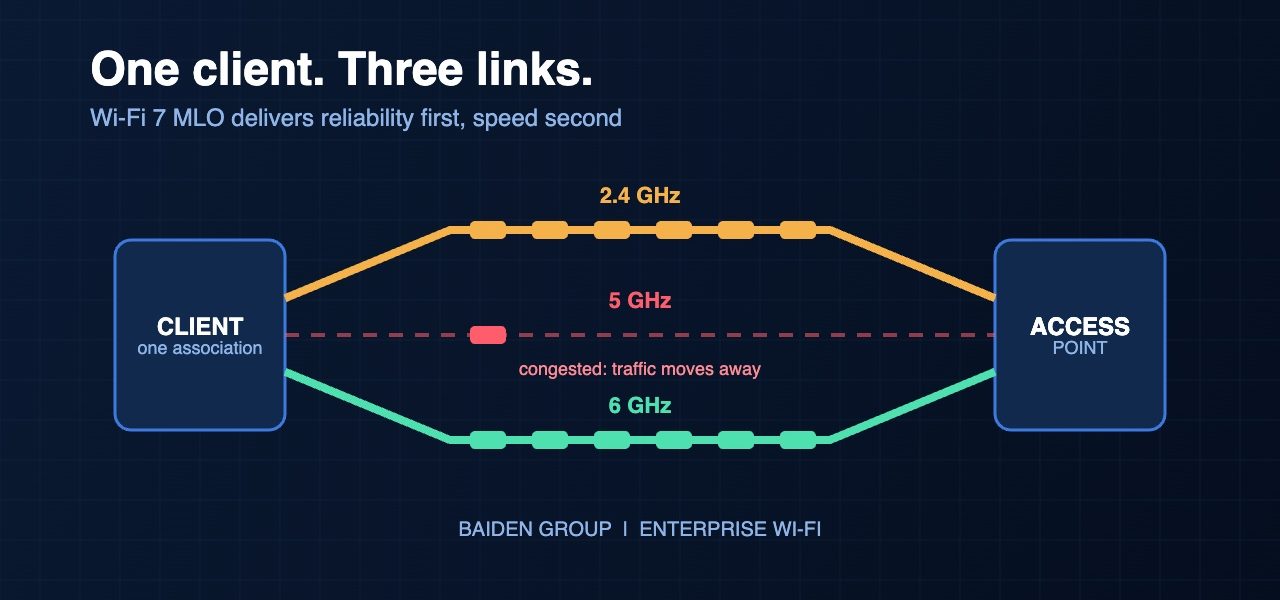
MLO changes this. A client associates once and holds several links to the same access point. Those links can span 2.4 GHz, 5 GHz, and 6 GHz. Consequently, traffic can use whichever link is clear at that moment. Furthermore, one failed link no longer drops the whole session.
The Modes Matter More Than the Brochure
Marketing material rarely mentions that MLO comes in several modes. Specifically, simultaneous transmit and receive, known as STR, uses each link independently. It needs separate radios and strong antenna isolation. Many client devices cannot do it.
In contrast, enhanced multi-link single radio, known as eMLSR, lets a client listen on two links and transmit on one. It improves latency and reliability. It does not add throughput. For example, a phone using eMLSR will not double its speed. It will, however, find the cleaner channel faster.
Therefore, ask your vendor which modes the access points and your actual client devices support. Often the honest answer is narrower than the datasheet suggests.
Where MLO Helps First
The biggest wins show up in environments with heavy contention. Hospitals, warehouses, and busy offices all fit that description. Handheld scanners and clinical devices need low latency more than raw speed. Consequently, MLO suits these roles well, provided the devices support it.
However, most client fleets in Canada still include older Wi-Fi 5 and Wi-Fi 6 hardware. Those devices gain nothing from MLO. In practice, you will run a mixed network for years. Therefore, audit your client inventory before you justify a refresh on MLO alone.
What the Trials Show
The Wireless Broadband Alliance ran Phase 2 trials with AT&T, Intel, and Ruckus. The results validated MLO for enterprise reliability and performance. Importantly, reliability is the benefit that matters most to IT teams. A hospital or a warehouse cares more about steady roaming than a headline speed number.
That said, trial conditions are controlled. Your building has steel racking, concrete walls, and older clients. As a result, your gains will vary. Only a site specific test can tell you by how much.
What This Means for Your Design
MLO does not fix poor RF design. In fact, it can hide problems for a while. A client with three links across weak coverage still has weak coverage. Roaming behaviour, minimum data rates, and cell sizing still decide the user experience. Meanwhile, a good survey shows where the real gaps sit. It also shows which of them MLO can never repair. Vendors rarely volunteer that point.
Notably, 6 GHz has a shorter range than 5 GHz. Access points may need denser placement to keep that link useful. Additionally, MLO clients add load across all three bands, so your channel plan needs a fresh review. For this reason, a predictive design and an RF site survey should come before any Wi-Fi 7 refresh. Also, confirm which 6 GHz power class your access points will use in Canada.
At Baiden Group, we design Wi-Fi 7 networks around measured conditions, not brochures. Our services cover Wi-Fi design, RF site surveys, troubleshooting, and managed Wi-Fi. Specifically, we test real client behaviour on site before you commit to a refresh.
Have questions about how these developments affect your network? Reach out to the Baiden Group team.