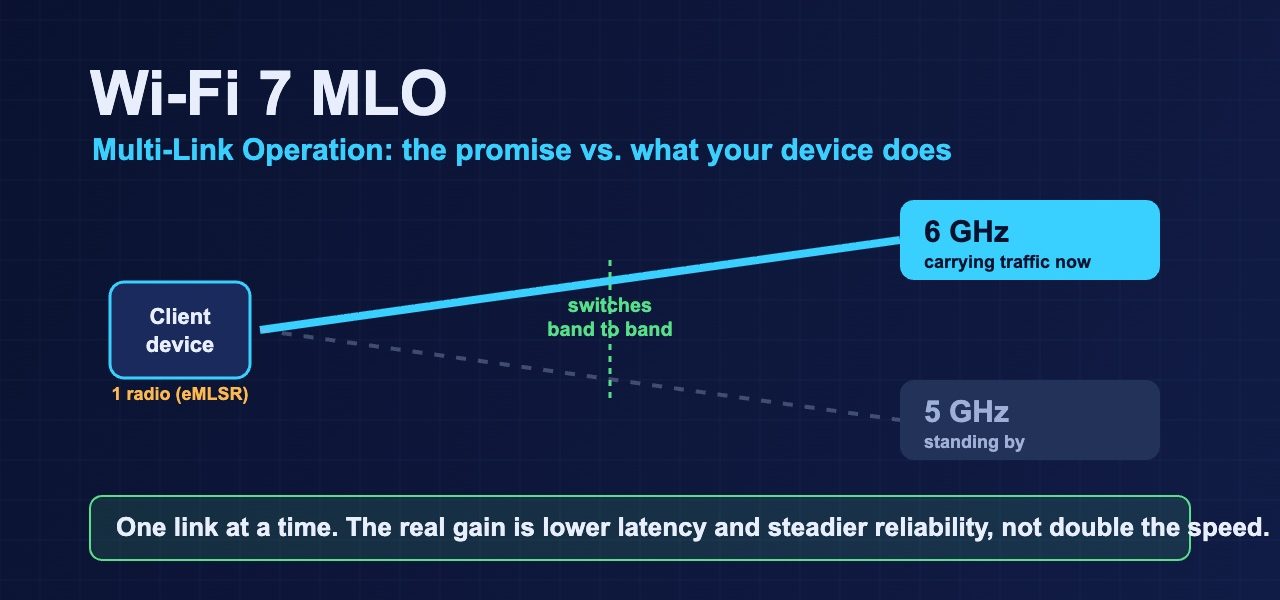
Wi-Fi 7 hit the enterprise market with a big promise. Multi-link operation, or MLO, would let a device use two or three bands at once. Vendors framed it as a way to double your throughput. However, the reality on a client device looks different from the slide deck. In practice, MLO delivers something more useful than raw speed, and IT teams should understand what that is before they sign a refresh order.
What vendors promise versus what the client sees
The marketing story is simple. Combine 5 GHz and 6 GHz into one connection and get the sum of both. Unfortunately, that is not how most clients behave. In fact, a typical laptop or phone still tops out at the speed of the single fastest band available. Multi-link does not stack bandwidth for the device the way the ads suggest. Therefore, if you bought Wi-Fi 7 MLO expecting your users to see double the numbers, you will be disappointed.
eMLSR is what your devices actually run
Here is the technical reason. There are two flavors of MLO that matter. STR, or simultaneous transmit and receive, uses independent radios on each band at the same time. That mode needs more hardware, and it costs more. Meanwhile, almost every phone, laptop, and Wi-Fi 7 adapter shipping today uses eMLSR instead. eMLSR runs a single radio that switches between bands very quickly. As a result, the client uses one link at a time, not both together. Consequently, the throughput ceiling stays tied to the fastest band.
Where MLO earns its keep
The real gains show up in latency and reliability. Because the radio can pick the cleaner band moment to moment, it dodges interference and congestion. For example, recent enterprise field trials measured up to 66 percent lower uplink latency for real time traffic. Additionally, the same trials showed up to 116 percent higher uplink throughput under interference. Notably, those gains appear when the air is busy, which is exactly when your users complain. In short, MLO is a reliability feature first and a speed feature second.
What this means for a Canadian Wi-Fi refresh
A few practical points matter before you buy. First, confirm the access point ships with real 6 GHz radios. Some early Wi-Fi 7 gear skipped the third band entirely. Second, plan your 6 GHz channels with care. The 320 MHz channels sound impressive, yet only three non-overlapping ones exist, so most dense sites should run 160 MHz instead. Third, check what your clients actually support. Ultimately, the network is only as capable as the devices connecting to it.
MLO is worth having, but it is not magic. For enterprise teams in Canada, the honest value is steadier performance in crowded spaces like hospitals, warehouses, and campuses. That said, the benefit only lands when the design accounts for band planning, client behavior, and real coverage. At Baiden Group, we handle Wi-Fi design, RF site surveys, troubleshooting, and managed Wi-Fi, and we validate these claims against what your building and your devices actually do. Have questions about how these developments affect your network? Reach out to the Baiden Group team.