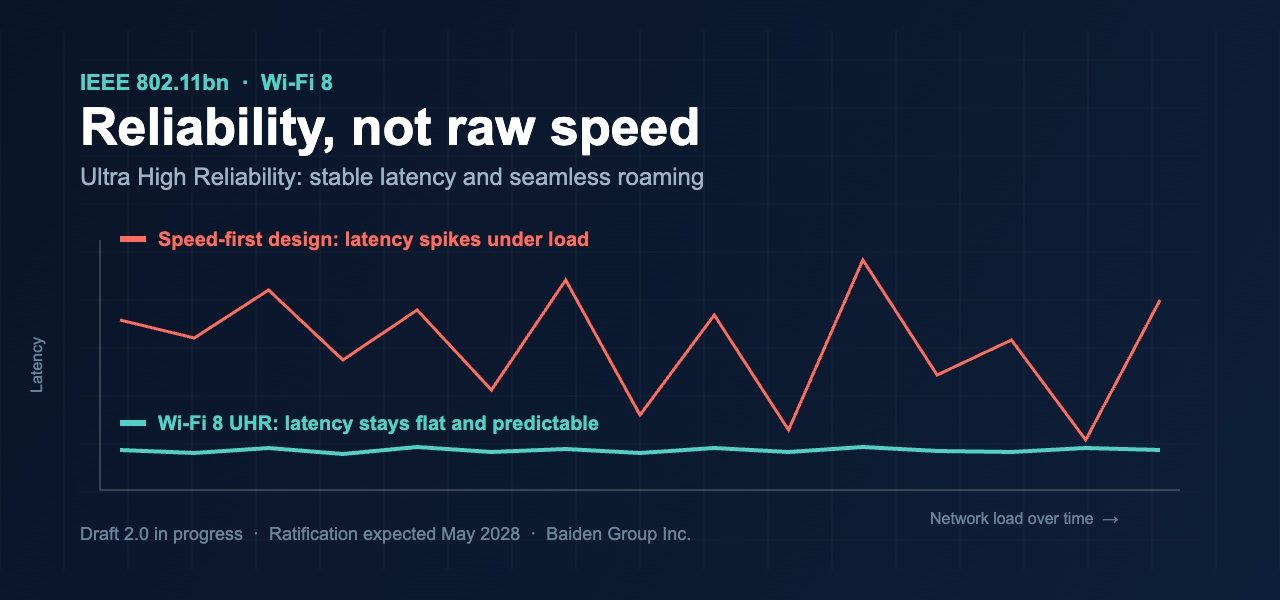
The IEEE 802.11 working group met in Montreal this July to push the next Wi-Fi standard forward. That standard is 802.11bn, better known as Wi-Fi 8. Notably, it will not be about faster speeds. Instead, it targets something enterprise networks need far more, which is reliability. For anyone running a large network in Canada, the IEEE 802.11bn Wi-Fi 8 direction is worth understanding now.
What the IEEE Is Actually Building
At the Montreal meeting, the working group aimed to approve Draft 2.0 of 802.11bn. Draft 1.4 cleared roughly 60 percent of comments back in March. Consequently, the specification is now feature complete in its core shape. However, final ratification is not expected until May 2028. That timeline matters, and I will come back to it.
The official name of 802.11bn is Ultra High Reliability, or UHR. For the first time, the headline goal is not peak throughput. Instead, the standard chases stable signal, predictable latency, and clean handoffs between access points. In practice, that is a direct response to how crowded enterprise environments have become.
Reliability Beats Raw Speed on Real Sites
I survey buildings for a living. Rarely is raw speed the problem. Generally the problem is a client that will not roam, a dead zone in a stairwell, or latency that spikes when the floor fills up. Wi-Fi 8 goes after exactly these failure modes.
Several features drive this. For example, Extended Multi-Link Operation lets a device hold links to more than one access point at once. As a result, roaming becomes smoother because the client does not drop one link before grabbing the next. Additionally, enhanced channel access lets high priority traffic preempt lower priority frames. For latency sensitive work like voice, that is a real gain.
There is also Cooperative Spatial Reuse and Cooperative Beamforming. In short, access points coordinate instead of fighting over airtime. On a hospital floor with dozens of APs, that coordination is worth more than another gigabit nobody uses.
What Canadian IT Teams Should Do Now
Here is the blunt part. Do not rush to buy Wi-Fi 8. The standard will not be ratified until 2028, and early silicon always ships ahead of the final spec. Therefore any Wi-Fi 8 gear you see in 2026 is built on a draft that can still change.
That said, the direction is worth planning around. If your current network struggles with roaming or latency, those are Wi-Fi 8 problems, and you do not need to wait three years to address them. In fact, most of the reliability wins start with good design, not new hardware. A proper RF survey, sane channel planning, and correct AP placement fix more roaming issues than any chipset.
Meanwhile, treat vendor Wi-Fi 8 claims with caution. Some marketing will promise speed numbers that miss the entire point of the standard. The point is reliability. Ask instead how a product handles roaming, latency, and dense client counts.
Ultimately, the Montreal meeting is a reminder that the industry is finally chasing what actually breaks on real networks. Reliability is what your users feel every day. At Baiden Group, we design, survey, troubleshoot, and manage enterprise Wi-Fi so your network holds up under real load, today and through the next standard.
Have questions about how these developments affect your network? Reach out to the Baiden Group team.